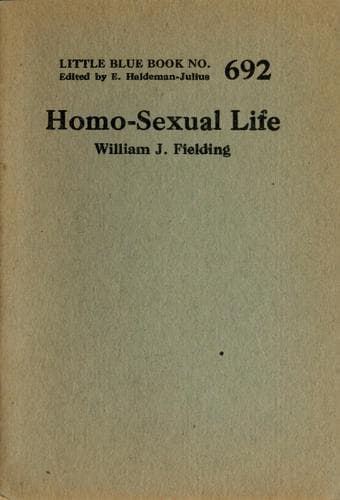
Homo-sexual lifeFielding, William J. (William John)
Science
Homo-sexual life
Fielding, William J. (William John)
Homosexuality; Sex (Psychology)
Another step up the evolutionary ladder we find the earthworm. Each
worm has the organs of the two sexes--the equivalent of testes and
ovaries,--properly developed, but each worm needs another worm to
induce fertilization. In this instance, we have true hermaphroditism,
and bisexuality is definitely established. However, as the two worms
are of the same sex--each being male as well as female--they are in
that way homosexual, as well, being attracted by worms of similar
constitution.
As life grows more complex and we ascend the biological scale, the
sexual processes also become more ramified, until in the higher forms
of life we find the sexual nature of the individuals of the different
genera and species sharply differentiated.
But even in the highest form of life, there are the vestigial organs
and characters of the opposite sex, so that while the normal human
being has a definite sexual category, it is just as truly apparent that
no individual is wholly of one sexual character. The most masculine man
is not one hundred per cent masculine, nor is the most feminine woman
one hundred per cent feminine. The proof of this will be shown as we
proceed in our discussion.
The physical bisexual characters--those of the opposite sex being
present in rudimentary form--are readily observable. In the male, there
are the vestigial breasts and nipples, and other rudimentary features
less prominent; and sometimes a general feminine contour of body is
noticeable in the male.
The most feminine of women have a growth of colorless hair, called
the “lanugo,” corresponding to the male beard. If the woman has a
larger proportion of masculine chemistry in her make-up, this hirsute
growth may be quite prominent; and in some cases very pronounced, as
in the instance of the bearded ladies who exhibit themselves in shows
and circuses. Women with a more or less definite masculine cast of
figure, movement, manner and voice are commonplace;--as is the opposite
phenomenon--effeminate men.
The psychological phases of bisexualism parallel the physical. We might
even go farther and state they are more in evidence than the physical,
as they are subject to modification by environmental influences to a
degree far exceeding the physical.
As was observed in the opening paragraph of this chapter, the
individual may suffer a retardation or fixation at any stage of
the sexual development, which holds him back into another and more
primitive psychical and emotional level, which he has chronologically
outgrown.
Public-domain text, read in full here on John Shaqi.
Reviews
Reviews
No reviews yet
Be the first to share your thoughts on this work.
Join the Discussion
Join the discussion
Sign in to leave a comment or review.
Sign InorCreate an account