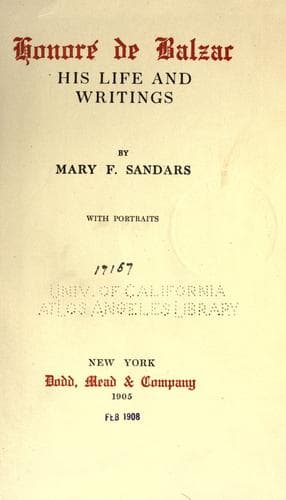
Honore de Balzac, His Life and WritingsSandars, Mary Frances
General
Honore de Balzac, His Life and Writings
Sandars, Mary Frances
Balzac, Honoré de, 1799-1850; Novelists, French -- 19th century -- Biography
Schemes still coursed each other through his quick-moving brain. He
wished to create an association of all the great dramatists of the
day, who should enrich the French stage with plays composed in common.
He was rather despondent about this, however, as he said that most
writers were cowardly and idle, and he as afraid they would therefore
refuse to join his society. Scribe was the only one who would work;
"Mais quelle litterature que 'Les Memoires d'un Colonel de Hussards!'"
he exclaimed in horror.[*] Another plan for becoming colossally rich
of which he talked seriously, was to gain a monopoly of all the arts,
and to act as auctioneer to Europe: to buy the Apollo Belvedere, for
instance, let all the nations compete for it against each other, and
then to sell to the highest bidder.
[*] "Notes Historiques sur M. de Balzac," by Champfleury.
He took a gloomy view of the political situation, because, though he
had a great admiration for Lamartine, he feared that the poet would
not have sufficient strength of mind, to take advantage of the great
majority he would doubtless have in the next Assemblee Constituante,
and to make himself the chief of a strong government, when he might
justify his magnificent _role_, by presiding at the accomplishment of
the great social and administrative reforms, demanded by justice, and
material, moral, and intellectual progress. In one of his remarks was
a touch of sadness. He told Lemer that, at the present crisis, all
authors should sacrifice their writing for a time, and throw
themselves with energy into politics. "Et pour cela il faut etre
jeune," he added with a sigh; "et moi, je suis vieux!"
However, on March 18th, 1848, a letter written by him appeared in the
_Constitutionnel_, in which he stated that he would stand as deputy if
requested to do so.[*] In consequence, the "Club de la Fraternite
Universelle" wrote to inform him that his name had been put on the
list of candidates for election, and invited him to explain his
political views at a meeting of the Club. In the _Constitutionnel_ of
April 19th Balzac answered this request by refusing to go to the
meeting, and at the same time announced that he had no intention of
canvassing, and wished to owe his election solely to votes not asked
for, but given voluntarily. He further commented on the fact that from
1789 to 1848 France had changed its constitution every fifteen years,
and asked if it were not time, "for the honour of our country, to
find, to found, a form, an empire, a durable government; so that our
prosperity, our commerce, our arts, which are the life of our
commerce, the credit, the glory, in short, all the fortune of France,
shall not be periodically jeopardised?"
[*] "Honore de Balzac," by Edmond Bire.
Naturally, these uncompromising views did not meet with favour from
the "citoyens membres du Club de la Fraternite Universelle," and
Balzac was not elected a member of the Assemblee Nationale.
CHAPTER XV
Public-domain text, read in full here on John Shaqi.
Reviews
Reviews
No reviews yet
Be the first to share your thoughts on this work.
Elsewhere in the archive
Join the Discussion
Join the discussion
Sign in to leave a comment or review.
Sign InorCreate an account