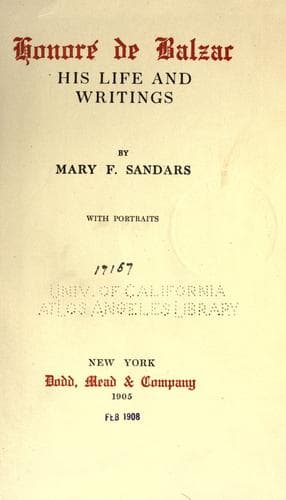
Honore de Balzac, His Life and WritingsSandars, Mary Frances
General
Honore de Balzac, His Life and Writings
Sandars, Mary Frances
Balzac, Honoré de, 1799-1850; Novelists, French -- 19th century -- Biography
His was a terrible dilemma. Ill and suffering, so that he was not able
to work to diminish his load of debt, desperately in love with a
cold-hearted woman, who used these debts as a lever for postponing what
on her side was certainly an undesirable marriage; and enormously
proud, so that failure in his hopes would mean to him not only a broken
heart, but also almost unbearable mortification; Balzac, crippled and
handicapped, with his teeth set hard, his powers concentrated on one
point, that of winning Madame Hanska, was at times hardly master of
himself. There was indeed some excuse for his irritation, when his
family wrote something tactless, or involved themselves in fresh
misfortunes, just as matters perhaps seemed progressing a little less
unfavourably than usual. Their letters were always read aloud at the
lunch table at Wierzchownia, and often, alas! their perusal served to
prove anew to Madame Hanska, the mistake she had made in contemplating
an alliance with a member of a family so peculiarly unlucky and
undesirable.
At last the smouldering indignation between Balzac and his relations
burst into a flame. The immediate cause of ignition was a letter from
Madame de Balzac, complaining that Honore had not written sufficiently
often to her; and further, that he did not answer his nieces'
epistles. These reproaches were received with much indignation, as
Balzac remarked in his answer, which was dated February, 1849, that he
had written seven times to his mother since his return to Wierzchownia
in September, and that he did not like to send letters continually,
because they were franked by his hosts. He goes on to say rather
sadly, that it will not do for him to trespass on the hospitality
offered him, because, though he has been royally and magnificently
received, he has still no rights but those of a guest. On the subject
of his neglect to write to his nieces, he is very angry, and cries in
an outburst of irritability: "It seems strange to you that I do not
write to my nieces. It is you, their grandmother, who have such ideas
on family etiquette! You consider that your son, fifty years old, is
obliged to write to his nieces! My nieces ought to feel very much
honoured and very happy when I address a few words to them; certainly
their letters are nice, and always give me pleasure."[*] A postscript
to the letter contains the words: "Leave the house in the Rue Fortunee
as little as possible, I beg you, because, though Francois is good and
faithful, he is not very clever, and may easily do stupid things."
[*] "Correspondance," vol. ii. p. 373.
Balzac followed this with another letter, which apparently impressed
on his mother that to please the Wierzchownia family she must behave
very well to him; and this communication naturally annoyed Madame de
Balzac even more than the preceding one.
Public-domain text, read in full here on John Shaqi.
Reviews
Reviews
No reviews yet
Be the first to share your thoughts on this work.
Elsewhere in the archive
Join the Discussion
Join the discussion
Sign in to leave a comment or review.
Sign InorCreate an account