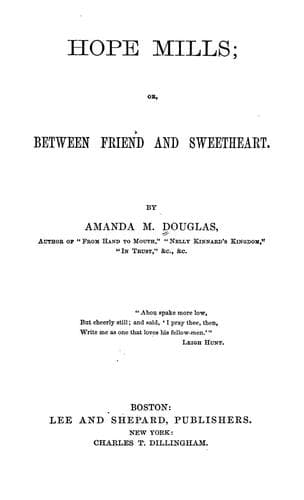
Hope Mills; Or, Between Friend and SweetheartDouglas, Amanda M.
Philosophy
Hope Mills; Or, Between Friend and Sweetheart
Douglas, Amanda M.
Fiction
She had her ambitions too, this bright little girl. They were tinctured
with the crudeness of youth, and its boundless vision, it is true; and
sometimes the passion of despair seized her soul in a cold grasp, when
she felt hemmed in on every side, and longed for some opening, some step
in the great world higher than fashionable frivolity.
Miss Barry had no taste for famous women. They were well enough in the
world: she paid a proper and polite deference to Mrs. Somerville, Mrs.
Browning, and Rosa Bonheur,--that kind of intellectual deference that
sets them out of the sphere of ordinary women. Wives and mothers were
better for the every-day life of the world; since pictures and poetry
were luxuries, accessories, but not home or food or clothes. Though she
had missed her woman's destiny, she had not lost faith in it; though she
had held out her hand to the woman who had made shipwreck of her own
life for the wild, graceless brother's sake, she still looked on clear
seas and smooth sailing as possible for lovers' barks. In her plans for
Sylvie there was a fine, manly, generous husband; a love so sweet and
entire that the girl should forget her restless yearnings; baby hands to
cling to her, baby lips to press, young lives to mould, and a future to
plan for others.
Miss Barry believed in work devoutly, but gentlewomen had a firm place
in her creed. The paintings and music were well enough as
accomplishments, and she was proud of them; but she delicately repressed
the other dreams and desires until Sylvie ceased to speak of them except
to her friend Jack.
Miss Barry had experienced some anxiety on this point, it must be
confessed. You would never have perceived it from the wise little
woman's face or any tone of her voice. She went more frequently to the
Darcys of an evening with Sylvie: she rolled her easy-chair and
work-table to the opposite side of the sitting-room, where it commanded
a view of the piano and the sofa in the parlor, the door being always
open. She could hear and see, she could make pleasant, trenchant
remarks: indeed, she was one of themselves, as young in heart, if the
hair did glisten silvery under the bit of exquisite thread-lace that did
duty as an apology for a cap.
Jack and Sylvie were not lovers. A rare good friendship it was, more
perfect than brotherly and sisterly regard, in that it held no
duty-element, and was spontaneous. Sylvie never laughed at Jack in his
awkward boyish days: he had never tormented her small belongings as
brothers are wont to do.
Miss Barry feared the flame might be easily fanned. A little opposition
or warning would bring Sylvie's innocent wandering thoughts to a focus,
and kindle the fire. She was very wary. She trusted Sylvie to Jack with
an air that said, "You are too honorable to betray the confidence I
repose in you."
Public-domain text, read in full here on John Shaqi.
Reviews
Reviews
No reviews yet
Be the first to share your thoughts on this work.
Join the Discussion
Join the discussion
Sign in to leave a comment or review.
Sign InorCreate an account