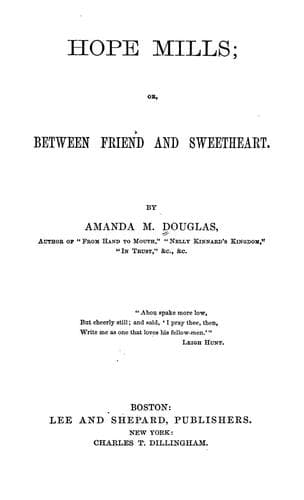
Hope Mills; Or, Between Friend and SweetheartDouglas, Amanda M.
Philosophy
Hope Mills; Or, Between Friend and Sweetheart
Douglas, Amanda M.
Fiction
The old class prejudice spoke out in this covert objection to Jack as
a suitor. She honored him sincerely for giving up the dreams of
ambitious and energetic manhood to stay at home and comfort these two
delicate women. Yet (strange contradiction) she had a half fancy that it
betokened weakness or lack of some kind in the very content with which
he seemed to go about his daily duties. Alas for consistency! We preach
content from the pulpit on Sunday, and on Monday glance with quiet
contempt on our plodding neighbor, who can commune with the daisies by
the wayside, while there is gold lying untroubled in desert gulches.
Honest, sturdy Jack, taking up the duty of to-day cheerfully with a
manful endurance, because the hands holding his fate were too weak and
tender to be wrestled with, and that in his large, generous soul he
could not war on a smaller antagonist, neither was it his nature to
continually thrust any sacrifice he might make before the eyes of the
one he was benefiting. How much silent heroism goes unpraised in the
world, while we stand on the highways, and prate of our discrimination,
our quick insight! Jack might be praised for his self-denial, but the
higher appreciation was withheld. Even Sylvie was fretted at times,
because he would get interested in all things pertaining to the mill.
Miss Barry said to herself, "It is best that Sylvie should marry in her
own circle, a man of cultivation, refinement, and position. Jack is a
dear good fellow, but not the person to satisfy her for a lifetime."
Jack thought nothing at all about it. He never gave up the idea of a
great wide world, where he could have a hand-to-hand struggle with
something as powerful as himself. He had come to no dreams of wife and
children. He did like Sylvie with all his big, honest heart. If she had
fallen in love with him, and betrayed it by some girlish sign, he would
have been startled at first, then thought it over in his slow, careful
way, asked her to marry him, and loved her devotedly all his days,
leaving the dreams to the past with a tender benediction.
But Sylvie was no more in love than he.
As I said, she decided that she was not needed at Hope Terrace, and
staid away four days. Then the carriage came, with a beseeching note.
Had Fred gone again?
She found him there in all his elegant listlessness. It exasperated her
strangely.
"What have you been about, Sylvie?" cried Mrs. Lawrence. "Is your aunt
ill? It seems a full week since you were here."
"Oh, no!" with her beguiling little smile. "I cannot tell exactly what,
only I thought"--
"You thought because Fred was home I would need no one else! As if a
love-story would not bore him, and an invalid's whims--well, men are not
women, my dear," decisively, and with a complacent expression as if she
had settled the argument beyond any question, for the first time since
the world began.
Public-domain text, read in full here on John Shaqi.
Reviews
Reviews
No reviews yet
Be the first to share your thoughts on this work.
Join the Discussion
Join the discussion
Sign in to leave a comment or review.
Sign InorCreate an account