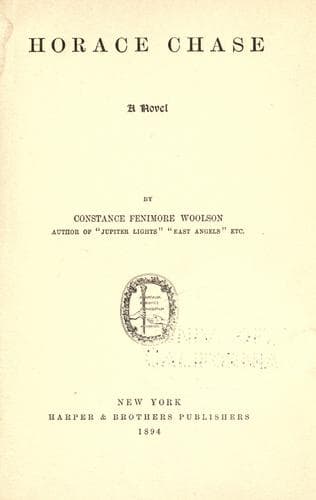
Didactic fiction; Men -- United States -- Fiction; United States -- Social life and customs -- 19th century -- Fiction
"Quite impossible, then, that Mrs. Jared should have known him when he
was a boy; she was not born at that time," commented Etheridge. "What
she means, of course, is that she, as a child herself, called him
'Horrie.'"
Mrs. Franklin did not answer, and at this moment Dolly came in.
"Yes, I am well," she said, in reply to the visitor's greeting; "we are
all well, and lazy. The world at large will never be helped much by us,
I fear; we are too contented. Have you ever noticed, commodore, that the
women who sacrifice their lives so nobly to help humanity seldom
sacrifice one small thing, and that is a happy home? Either they do not
possess such an article, or else they have spoiled it by quarrelling
with every individual member of their families."
"Now, Dolly, no more of your sarcasms. Tell me rather about this new
acquaintance of yours, this bubbling capitalist whom you have invented
and set up in your midst during my unsuspecting absence," said
Etheridge.
"You need not think, commodore, that you can make me say one word about
him," answered Dolly, solemnly; "for I read in a book only the other day
that a tendency to talk about other persons, instead of one's self, was
a sure sign of advancing age. Young people, the book goes on to say, are
at heart interested in nothing on earth but themselves and their own
affairs; they have not the least curiosity about character or traits in
general. As I wish to be considered young, I have made a vow to talk of
nothing but myself hereafter. Anything you may wish to hear about _me_
I am ready to tell you." Dolly was now attired in a velvet dress of dark
russet hue, like the color of autumn oak leaves; this tint took the eye
away somewhat from the worn look of her plain thin face. The dress,
however, was eight years old, and the fashion in which it had been made
originally had never been altered.
"The being interested in nothing but themselves, and their own doings
and feelings, is not confined to young people," said Mrs. Franklin,
laughing. "I have known a goodly number of their elders who were quite
as bad. When these gentry hold forth, by the hour, about their
convictions and their theories, their beliefs and disbeliefs, their
likings and dislikings, their tastes and their principles, their souls,
their minds, and their bodies--if, in despair, you at last, by way of a
change, turn the conversation towards some one else, they become loftily
silent. And they go away and tell everybody, with regret of course, that
you are hopelessly given to gossip! Gossip, in fact, has become very
valuable to me; I keep it on hand, and pour it forth in floods, to drown
those egotists out."
"When you gossip, then, I shall know that _I_ bore you," said Etheridge,
rising, "I mustn't do so now; I leave you to your Bubble. Mrs. Jared, I
suppose, will be with you this evening? I ask because I had thought of
paying her a how-do-you-do visit, later."
Public-domain text, read in full here on John Shaqi.
Reviews
Reviews
No reviews yet
Be the first to share your thoughts on this work.
Join the Discussion
Join the discussion
Sign in to leave a comment or review.
Sign InorCreate an account