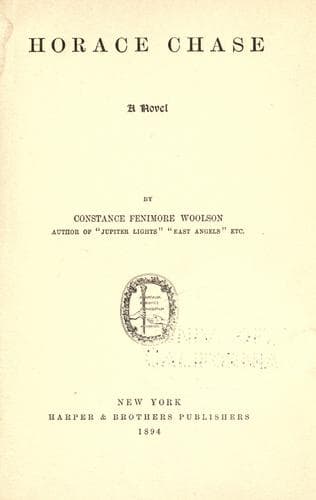
Didactic fiction; Men -- United States -- Fiction; United States -- Social life and customs -- 19th century -- Fiction
"Yes; she knew Mr. Chase when he was a little boy; she says she used to
call him Horrie. As soon as she heard that he was here, she revived the
acquaintance; and then she introduced him to us."
"Does she _like_ him?" asked Etheridge, with annoyance in his tone.
"I don't know whether she likes him or not; but she is hoping that he
will do something that will increase the value of property here."
"It is intelligent of Mrs. Jared to be thinking of that already," said
Etheridge, softening a little. "Perhaps if I owned land here, I should
take another view of the subject myself! You too, Dora--you might make
something?"
"No; we have no land save the garden, and the house is dreadfully
dilapidated. Personally, I may as well confess that I should be glad to
see the railroad arrive; I am mortally tired of that long jolting
stage-drive from Old Fort; it nearly kills me each time I take it. And I
am afraid I don't care for nature undraped so much as you do, commodore;
I think I like draperies."
"Of course you do! But when you--and by you I mean the nation at
large--when you perceive that your last acre of primitive forest is
forever gone, then you will repent. And you will begin to cultivate
wildness as they do abroad, poor creatures--plant forests and guard 'em
with stone walls and keepers, by Jove! Horace Chase appears here as the
pioneer of spoliation. He may not mean it; he does not come with an axe
on his shoulder exactly; he comes, in fact, with baking-powder; but
that's how it will end. Haven't you heard that it was baking-powder? At
least you have heard of the powder itself--the Bubble? I thought so.
Well, that's where he made his first money--the Bubble Baking-Powder;
and he made a lot of it, too! Now he is in no end of other things. One
of them is steamships; some of the Willoughbys of New York have gone in
with him, and together they have set up a new company, with steamers
running south--the Columbian Line."
"Yes, Genevieve explained it to us. But as he does not travel with his
steamers round his neck, there remains for us, inland people as we are,
only what he happens to be himself. And that is nothing interesting."
"Not interesting, eh?" said Etheridge, rather gratified.
"To my mind he is not. He is ordinary in appearance and manners; he says
'yes, ma'am,' and 'no, ma'am,' to me, as though I were a
great-grandmother! In short, I don't care for him, and it is solely on
Genevieve's account that I have invited him. For she keeps urging me to
do it; she is very anxious to have him like Asheville. He has already
dined with us twice, to meet her. But to-day he comes informally--a
chance invitation given only this morning (and again given solely to
please _her_), when I happened to meet him at the Cottage."
"How old is the wretch?"
"I don't know. Forty-four or forty-five."
Public-domain text, read in full here on John Shaqi.
Reviews
Reviews
No reviews yet
Be the first to share your thoughts on this work.
Join the Discussion
Join the discussion
Sign in to leave a comment or review.
Sign InorCreate an account