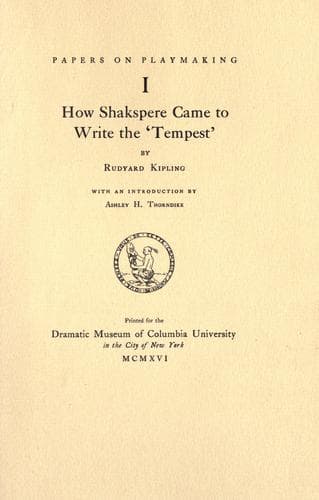
How Shakspere Came to Write the TempestKipling, Rudyard
General
How Shakspere Came to Write the Tempest
Kipling, Rudyard
Shakespeare, William, 1564-1616. Tempest
Then enter Nymphs, "Naiads of the winding brooks with sedg'd crowns,"
and Sun burnt Reapers, "with rye-straw hats." These are the main
masquers and join in a graceful dance, until upon Prospero's sudden
start--"to a strange, hollow, and confused noise, they heavily vanish."
More ingenious is Shakspere's use of the anti-masques--i.e. dances by
professional performers drest in fantastic costumes as animals, satyrs,
statues, witches, etc. Such are the several strange shapes of III.3, who
first bring in the banquet and again enter "and dance with mocks and
mows and carrying out the table"; and in IV.1, the divers spirits who
"in shape of dogs and hounds" hunt about the drunken conspirators while
Prospero and Ariel set them on.
For a stage, then, that had long been used to romance, Shakspere planned
a new wonderment. For it he revived some of his old creations from
Illyria and Arden, and Fairyland, all transformed by
a sea change
Into something rich and strange.
And he added some excitements and novelties to keep pace with the
thrilling tragi-comedies of Beaumont and Fletcher. And just as years
before, in the 'Midsummer Night's Dream,' he had drawn hints from the
court entertainments by children, so now he conceived a spectacle
that--so far as was possible--might rival the great shows of the
Jacobean court. He did not need to go beyond the drama to find abundant
suggestions for his new venture.
But this was to be a play as well as a show, and must have some kind of
plot. Perhaps he found an Italian novella with the story. No one has
been able to find it since then. But stories somewhat similar to that of
the 'Tempest' occur in a Spanish tale and in a German play. There was
indeed a real Alfonso, king of Naples, and a duke of Milan who was
dispossesst, and another named Prospero. But whatever story Shakspere
found, it is my notion that he forgot most of it. The palace intrigues,
the rivalries of the banisht and usurping dukes, set at naught by the
love at first sight of their children, the perilous adventures, and the
_dénouement_ brought about by magic, were commonplaces of fiction.
Shakspere wanted to weld them into a more surprising fable.
Perhaps it was at the very moment when he was most intent on this
problem that the sailor from the fleet of Sir Thomas Gates hove into
view. Even the mariner's ballast of facts did not quite suffice. As
Shakspere wrote he recalled some lines from his old favorite Ovid to
fill out one of Prospero's descriptions; and he used the newly-read
Montaigne for Gonzalo's account of a Utopian commonwealth. And some fine
lines from Sir William Alexander's tragedy of 'Darius' seem to have
lingered in his recollection when he wrote of the great globe which is
like a pageant and life that is like a dream. As he wrote of Prospero he
thought too of his own career, of his own so potent art, of his promised
retirement, and the fading pageants of both life and art.
Public-domain text, read in full here on John Shaqi.
Reviews
Reviews
No reviews yet
Be the first to share your thoughts on this work.
Join the Discussion
Join the discussion
Sign in to leave a comment or review.
Sign InorCreate an account