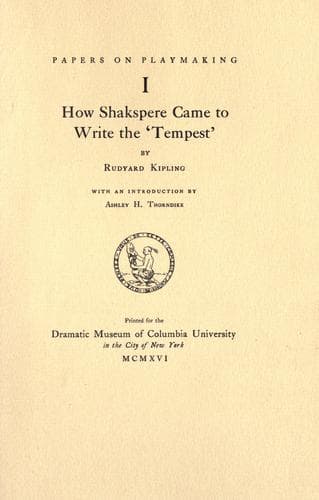
How Shakspere Came to Write the TempestKipling, Rudyard
General
How Shakspere Came to Write the Tempest
Kipling, Rudyard
Shakespeare, William, 1564-1616. Tempest
These shows were given in great halls, brilliantly lighted. The stage
was splendidly decorated. Gods and goddesses floated among the clouds,
and elaborate machines and scenes were devised. In one masque, a few
years before the 'Tempest,' "an artificial sea was seen to shoot forth
over the stage as it flowed to land, [this was the main machine--a great
stage four feet high on trestles] on which was a great concave shell
like mother of pearl" containing the masquers and conveyed by many
sea-monsters hidden by the torch-bearers. The costumes of the masquers
were in brilliant colors and heavily jeweled. These were often bizarre;
but Inigo Jones knew the monuments of classical antiquity and the
artistic achievements of Renaissance Italy as well as Jonson knew
classical and humanistic literature. The living pictures were often in
richness and color no unworthy rivals of the frescoes with which Rubens
had decorated the ceiling of the Masquing Hall.
Such expensive spectacles were beyond the reach of the professional
theaters, but contemporary dramatists frequently found something that
could be adapted or imitated for the public stage. So the antick dance
of satyrs in a 'Winter's Tale' (three of whom are announced as having
already appeared before the King) seems borrowed from an anti-masque in
Ben Jonson's 'Masque of Oberon.' In two plays of nearly the same date
there is a well defined effort to combine the masque and the regular
drama into a distinctive and novel dramatic entertainment, in the 'Four
Plays in One' of Beaumont and Fletcher and the 'Tempest' of Shakspere.
The 'Tempest' has always been a spectacular play on the stage, and so it
must have appeared to him--and as a spectacle having many of the
features of the court masque.
There is music and song. Ariel, Prospero, and even Caliban are proper
figures for a court show. The "masque proper" is used to celebrate the
betrothal in the fourth act. This is a simplified form of such a masque
as would be given at court. There is evidently some machinery--it is the
insubstantial pageant that calls forth Prospero's famous lines. Ariel,
Iris, Ceres, and Juno appear, Juno descending from the heavens. There is
music and a song, and Ferdinand cries:
This is a most majestic vision, and
Harmonious charmingly. May I be bold
To think these spirits?
And when Prospero says they are spirits summoned by his art, Ferdinand
exclaims
Let me live here ever;
So rare a wond'red father and a wise
Makes this place Paradise.
It is not Miranda now, but the machine and costumes used in
court-spectacles that turn the platform into a land of romance.
Public-domain text, read in full here on John Shaqi.
Reviews
Reviews
No reviews yet
Be the first to share your thoughts on this work.
Join the Discussion
Join the discussion
Sign in to leave a comment or review.
Sign InorCreate an account