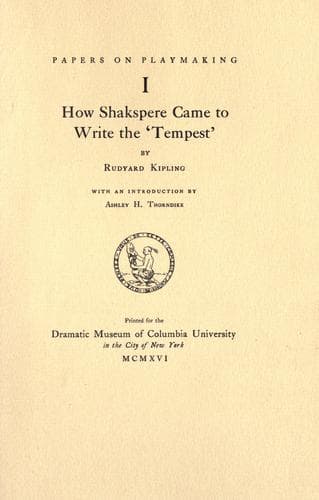
How Shakspere Came to Write the Tempest — John Shaqi
How Shakspere Came to Write the TempestKipling, Rudyard
General
How Shakspere Came to Write the Tempest
Kipling, Rudyard
Shakespeare, William, 1564-1616. Tempest
Shakspere created that land as the possession of each of us. Not far
removed, but close to the great continent of our daily routine and
drudgery, lies this enchanted island where we may find music and
moonlight and feeling, and also fun and mischief and wisdom. There, in
tune with the melody and transfigured as by the charm of moonlight, we
may encounter the nonsense of drunken clowns, the mingled greed and
romance of primitive man, the elfishness of a child, the beauty of
girlhood, and the benign philosophy of old age. We may leave the city at
the close of business, and, if we avoid the snares of Caliban and
Trinculo, we may sup with Prospero, Ariel, and Miranda.
How did Shakspere discover this enchanted island? From what materials
did he create the "baseless fabric of this vision"? What had London
playhouses to do with these spirits of thin air? On what books or plays
were these dreams made? Out of the issues of rivalry and profit which
beset the King's company of players at the Globe and the Blackfriars,
how came this "insubstantial pageant"? We have been told that the
Sonnets are the key with which to unlock Shakspere's heart; and perhaps
if we could answer all these questions we might have the key to his
imagination. I do not believe, however, that his imagination was lockt
up. Rather it was open wide to many impulses, hospitable to countless
influences. This apparently is the opinion of Mr. Kipling, who suggests
that Shakspere's "vision was woven from the most prosaic material, from
nothing more promising, in fact, than the chatter of a half-tipsy sailor
at the theater."
Mr. Kipling writes as one inventor of tales about another. Certainly no
one is better qualified to trace out the processes of the creative
imagination and to discover the very fabrics of its visions. In those
marvelous stories of his, who has not recognized a Shaksperian
catholicity in the quest of fact and a Shaksperian alchemy in its
transformation? He has himself created many enchanted islands and he
knows whereof they are made. The sailor just home from a famous
shipwreck on the Bermudas might have stept out of one of Mr. Kipling's
tales; but he becomes a factor in some very acute criticism, for the
sailor's "profligate abundance of detail at the beginning, when he was
more or less sober, supplied and surely established the earth-basis of
the play in accordance with the great law that a story to be truly
miraculous must be ballasted with facts."
Public-domain text, read in full here on John Shaqi.
Reviews
Reviews
No reviews yet
Be the first to share your thoughts on this work.
Join the Discussion
Join the discussion
Sign in to leave a comment or review.
Sign InorCreate an account