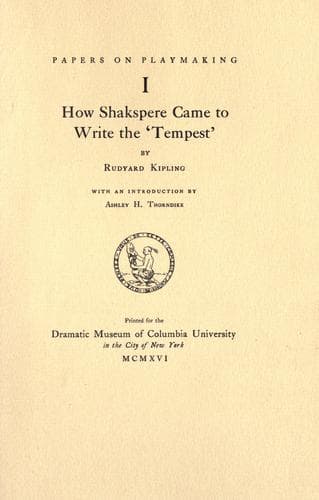
How Shakspere Came to Write the TempestKipling, Rudyard
General
How Shakspere Came to Write the Tempest
Kipling, Rudyard
Shakespeare, William, 1564-1616. Tempest
Mr. Kipling's letter has found a place in all subsequent critical
discussions of the play, and has become a contribution to that
historical research which seeks to discover the ways and means by which
literature is made. It may not be unseemly therefore to bring together
as an introduction and commentary some other suggestions that criticism
has advanced in regard to the influences and incentives that directed
Shakspere's art in this play, written at the very close of his career
and at the moment when the Elizabethan drama had reached its highest
development.
Recent investigation has added to our certainty that the play was
written in 1610 or 1611, for Mr. Ernest Law has shown that the
supposedly forged entry of its performance at court on November 1, 1611
is genuine. Various passages in the play indicate that it was not
written before July 1610, when Sir Thomas Gates and his ships sailed up
the Thames with news of the safety of the fleet that had departed from
Plymouth over a year before. This fleet of nine vessels had started for
the new colony in Virginia, had been scattered by a great storm, and the
ship 'Sea Venture' with the leaders aboard, Sir George Somers, Sir
Thomas Gates, and Captain Christopher Newport, had been cast ashore on
one of the Bermudas. But there had been no loss of life; the adventurers
had lived comfortably for many months, had built two pinnaces from the
materials of the wreck, and had rejoined their comrades in Virginia.
Before the arrival of Gates from Virginia, reports of the wreck had
reached London, so his safe return was a nine days wonder. Full accounts
were written. Two were printed in the autumn, and others circulated in
manuscript. Shakspere certainly read some of the pamphlets recounting
the strange experiences of the expedition, and he made some use of other
voyagers' tales, as Raleigh's 'Discovery of Guiana.' But he may have
heard much more than he read in the common gossip of the day. Or, enter
Mr. Kipling's sailor, "the original Stephano fresh from the seas and
half-seas over."
Public-domain text, read in full here on John Shaqi.
Reviews
Reviews
No reviews yet
Be the first to share your thoughts on this work.
Join the Discussion
Join the discussion
Sign in to leave a comment or review.
Sign InorCreate an account