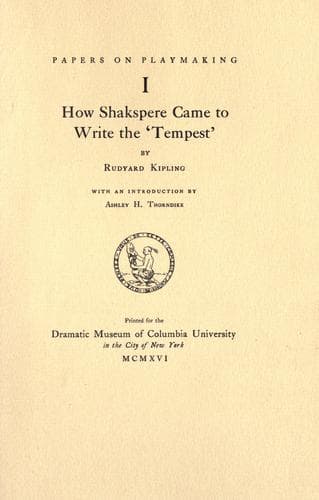
How Shakspere Came to Write the TempestKipling, Rudyard
General
How Shakspere Came to Write the Tempest
Kipling, Rudyard
Shakespeare, William, 1564-1616. Tempest
From this original Stephano or from the voyagers' tales may have come
some hints for Caliban. There were many strange accounts of cannibals
and monsters. An earlier narrative tells of "a sea monster ... arms like
a man, without hair and at the elbows great fins like a fish." Indians
had been brought back from America; and only a few years before the play
several had been exhibited and aroused much curiosity. As Trinculo
observes, "When they will not give a doit to relieve a lame beggar, they
will lay out ten to see a dead Indian." Caliban was doubtless intended
to be of the earth, earthy, the opposite of Ariel, the spirit of the
air, and was also intended as a sketch of the savage resisting the
mastery of the European. But, brutish and savage though he be, he too is
a dweller in the enchanted island. For him too life has its romance.
There is no finer touch of Shakspere's magic in the whole play than
this. Marco Polo had recounted that "You shall heare in the ayre the
sound of tabers and other instruments, to put the travellers in fear,
&c., by evill spirits that make these sounds and also do call ...
travellers by their names." But Shakspere's Caliban reassures his
companions frightened by Ariel playing on a tabor.
Be not afeard. The isle is full of noises,
Sounds and sweet airs, that give delight and hurt not.
Sometimes a thousand twangling instruments
Will hum about mine ears, and sometimes voices
That, if I then had wak'd after long sleep,
Will make me sleep again; and then, in dreaming,
The clouds methought would open and show riches
Ready to drop upon me, that, when I wak'd,
I cried to dream again.
The enchanted island owes still more to preceding voyagers in the great
seas of romance. Shakspere had made many earlier voyages thither, but he
was not the first Columbus to search out the undiscovered lands of
illusions and enchantments. Fortunately for us he lived in the period of
imaginative adventure and steered his crafts on the oceans whence many
predecessors had returned treasure-laden. This is no place to relate the
various circumstances that placed the men of the sixteenth century in a
fortunate position for Romance, or to indicate the long development of
romantic-comedy in which Shakspere played so great a part. But surely
the interview between the dramatist and the sailor would have had very
different results if the Elizabethan theater had not been accustomed to
the union of the laughable and the romantic, the comic and the
marvellous. Such a union is not a common one. There are no
romantic-comedies in the literature of antiquity, and very few in modern
literature since Shakspere's death. He found a stage that was already
the home of romance, used to fantasy and medley, and used also to fill
out a three hours entertainment with sentiment and fun, music and
monsters, idealized heroines and puns.
Public-domain text, read in full here on John Shaqi.
Reviews
Reviews
No reviews yet
Be the first to share your thoughts on this work.
Join the Discussion
Join the discussion
Sign in to leave a comment or review.
Sign InorCreate an account