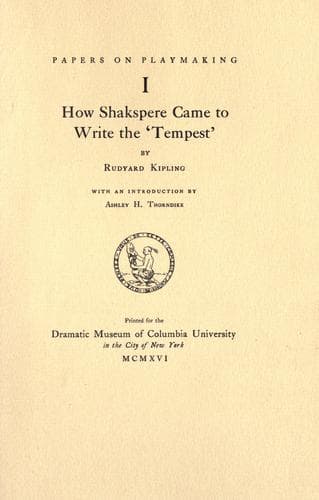
How Shakspere Came to Write the TempestKipling, Rudyard
General
How Shakspere Came to Write the Tempest
Kipling, Rudyard
Shakespeare, William, 1564-1616. Tempest
If Shakspere's mind was directed again to romantic themes and situations
by the success of Beaumont and Fletcher's plays, the clearest evidence
of his indebtedness to them is to be found in his 'Cymbeline', which has
many marked similarities to their 'Philaster'. In his two plays which
follow, the 'Winter's Tale' and the 'Tempest', there is no detailed
resemblance to the romantic tragic-comedies of the younger men.
Shakspere, as well as they, had the whole tradition of romantic drama to
draw from, and in particular he had his own past practice. He did not
need to be shown how to depict romantic love, or charming heroines, or
ardent suitors. For drinking scenes, like those of Trinculo and
Stephano, or for dialog like that not very witty one of Gonzalo and the
courtiers, he had many passages in his own plays that served as guides.
Moreover, if 'Cymbeline' is an example of only partially successful
experimentation with new methods, the 'Winter's Tale,' and still more,
the 'Tempest,' seem to me triumphant and unguided excursions of his own
in the new field. But I think that Shakspere was attracted to this field
by contemporary stage-successes, and that in seeking for novel and
invented plots, in the contrast of tragic and idyllic elements, in the
unusual and rapidly shifting situations, in the loose and parenthetical
style, and in the elaboration of the _dénouement_, he was adapting
himself to the new formulas and fashions in which Beaumont and Fletcher
were the leaders.
Still another suggestion came from the theater, but this time from the
court. The court shows of the sort which we have noticed as
characteristic of the early years of Elizabeth's reign had given place
to a better ordered and more sumptuous spectacle, the Court Masque.
Under James I, with the great architect Inigo Jones to devise the
machines and setting, and with Ben Jonson to write the librettos, one of
these masques was a magnificent affair. It was given on festal occasions
at court and often cost thousands of pounds. It had but a single or at
most two performances, always at night, and it came to follow a
distinct formula. The kernel of the show was the masked dance in which
members of the court, even King and Queen, took part. This dance or
"masque proper," often elaborated into several measures, came near the
end of the show. As accompaniments there were (1) music, instrumental
and vocal, (2) a play of some length, usually with mythological or
allegorical motive, (3) various grotesque dances by professional
performers, preceding the main masque and often integrated with the
play, and (4) a spectacular stage-setting.
Public-domain text, read in full here on John Shaqi.
Reviews
Reviews
No reviews yet
Be the first to share your thoughts on this work.
Join the Discussion
Join the discussion
Sign in to leave a comment or review.
Sign InorCreate an account