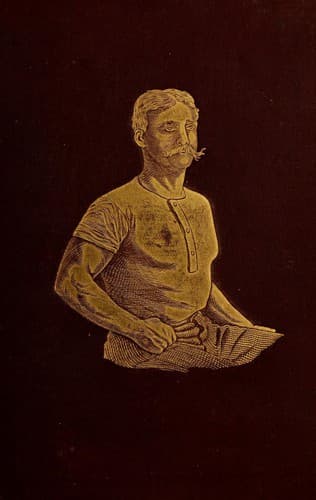
How to Get Strong and How to Stay SoBlaikie, William
Science
How to Get Strong and How to Stay So
Blaikie, William
Physical education and training
Nor are the gymnasiums of our cities and towns much better off. New York
city to-day, with one or two exceptions, is utterly without a gymnasium
worthy of her. Two of the best known are situated, one far below the
street level, the other directly over a stable, and formerly at least, if
not still, a very redolent stable at that. There is generally plenty of
apparatus, most of which is good enough; but the boy or man who comes to
use it finds at once the same things wanting as does the student in the
college gymnasium. If he can already raise a heavy dumb-bell over his head
with his right hand, he may, and often does, go on increasing his power in
this single direction, but in years actually gains little or no size or
strength in his other arm, his legs, or any other part of his body. No one
stops him, or even gives him an idea of the folly of his course; indeed,
no one has the power to do so. Ordinarily the place is kept by a man
simply to make a living. This secured, his ambition dies. He may be a
boxer or an acrobat, or even a fair general gymnast. With one or two
exceptions, we have yet to hear of an instance where the instructor has
either devised a plan of class exercise which has proved attractive, or in
a given time has brought about a decided increase in size and strength to
a majority of his pupils in a specific and needed direction.
College rowing and base-ball, while often unquestionably benefiting those
who took part in them, have been found to work detrimentally, but in a
way, as will be shown in a moment, certainly not expected by the public.
The colleges in this country which pay most attention to rowing are
Harvard, Yale, Cornell, and Columbia. It is well known that in both Oxford
and Cambridge universities the men who row are numbered by hundreds; that
over twenty eight-oared crews alone, to say nothing of other classes, are
sometimes on the river at once, and that the problem for the "'Varsity"
captain is not, as here, to find eight men all fitted for places in the
boat, but, out of many fit, to tell which to take. For years the American
press has reported the performances of our student oarsmen even oftener
and more fully than the English non-sporting papers those of their own
oarsmen, so that they have filled a larger space in the public eye. Men
naturally thought that the interest among the students themselves was
well-nigh universal, and many fathers expressed misgivings about sending
sons to institutions where the regular curriculum seemed a secondary
matter, and performance in athletic contests the chief thing.
Public-domain text, read in full here on John Shaqi.
Reviews
Reviews
No reviews yet
Be the first to share your thoughts on this work.
Join the Discussion
Join the discussion
Sign in to leave a comment or review.
Sign InorCreate an account