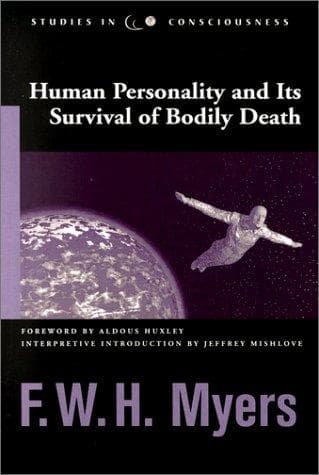
Human Personality and Its Survival of Bodily DeathMyers, F. W. H. (Frederic William Henry)
Religion
Human Personality and Its Survival of Bodily Death
Myers, F. W. H. (Frederic William Henry)
Immortality; Parapsychology; Personality
Between the aspects of love here expressed in extreme terms,--the
planetary aspect, if I may so term it, and the cosmical,--the choice is
momentous. I do not indeed say that in our estimate of love is involved
our estimate of Religion; for Religion should mean the sane response of
the spirit to all that is known of Cosmic Law. But Religion in the sense
in which it is often used,--our emotional and ethical attitude towards
Life Unseen;--this is in reality too closely parallel to Platonic Love
to allow the psychologist who denies reality in the one to assume
reality in the other. For the Platonic lover the image of the Beloved
one--no longer a matter of conscious summons and imagination--has become
the indwelling and instinctive impulse to noble thought and deed. Even
such to a Francis or to a Theresa is the image of the Divinity whom they
adore; and if they claim that sometimes in moments of crisis they feel a
sway, a guidance, a _communicatio idiomatum_ with the Divine, we may
point in reply to the humbler, but more tangible, evidence which assures
us that even between souls still inhabiting and souls who have quitted
the flesh there may exist a telepathic intercommunication and an
impalpable confluence from afar.
Brief as this survey has been, it has served to indicate that the
psychical type to which we have applied the name of genius may be
recognized in every region of thought and emotion, as in each direction
a man's every-day self may be more or less permeable to subliminal
impulses. Coming, then, to the question, "What is the origin of genius?"
I cannot accept the ordinary explanation that it is a mere "sport" or
mental by-product, occurring as physical "sports" do in the course of
evolution. The view which I hold,--the view which I am here suggesting,
is in some sort a renewal of the old Platonic "reminiscence," in the
light of that fuller knowledge which is common property to-day. I hold
that in the protoplasm or primary basis of all organic life there must
have been an inherent adaptability to the manifestation of all faculties
which organic life has in fact manifested. I hold, of course, that
"sports" or variations occur, which are at present unpredictable, and
which reveal in occasional offspring faculties which their parents
showed no signs of possessing. But I differ from those who hold that the
faculty itself thus manifested is now for the first time initiated in
that stock by some chance combination of hereditary elements. I hold
that it is not initiated, but only revealed; that the "sport" has not
called a new faculty into being, but has merely raised an existing
faculty above the threshold of supraliminal consciousness.
Public-domain text, read in full here on John Shaqi.
Reviews
Reviews
No reviews yet
Be the first to share your thoughts on this work.
Elsewhere in the archive
Join the Discussion
Join the discussion
Sign in to leave a comment or review.
Sign InorCreate an account