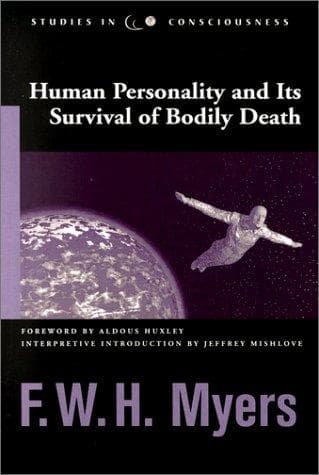
Human Personality and Its Survival of Bodily DeathMyers, F. W. H. (Frederic William Henry)
Religion
Human Personality and Its Survival of Bodily Death
Myers, F. W. H. (Frederic William Henry)
Immortality; Parapsychology; Personality
We see in travelling clairvoyance,[117] just as we see in
crystal-visions, a kind of fusion of all our forms of supernormal
faculty. There is telepathy, telæsthesia, retrocognition, precognition;
and in the cases reported by Cahagnet, which will be referred to in
Chapter IX., there is apparently something more besides. We see, in
short, that any empirical inlet into the metetherial world is apt to
show us those powers, which we try to distinguish, coexisting in some
synthesis by us incomprehensible. Here, therefore, just as with the
crystal-visions, we have artificially to separate out the special class
of phenomena with which we wish first to deal.
In these experiments, then, there seems to be an independent power of
visiting almost any desired place, its position having been perhaps
first explained by reference to some landmark already known. The
clairvoyante (I use the female word, but in several cases a man or boy
has shown this power) will frequently miss her way, and describe houses
or scenes adjacent to those desired. Then if she--almost literally--gets
on the scent,--if she finds some place which the man whom she is sent
to seek has some time traversed,--she follows up his track with greater
ease, apparently recognising past events in his life as well as present
circumstances.
In these prolonged experimental cases there is thus time enough to allow
of the clairvoyante's traversing certain places, such as empty rooms,
factories, and the like, whither no assignable link from any living
person could draw her. The evidence to prove telæsthesia, unmixed with
telepathy, has thus generally come _incidentally_ in the course of some
experiment mainly telepathic in character.
These long clairvoyant wanderings are more nearly paralleled by _dreams_
than by waking hallucinations.
In a case which I will here quote a physician is impressed, probably in
dream, with a picture of a special place in a street, where something is
happening, which, though in itself unemotional--merely that a man is
standing and talking in the street--is of moment to the physician, who
wants to get unobtrusively into the man's house.
From _Phantasms of the Living_, vol. i. p. 267. The case is there
described as coming "from a Fellow of the College of Physicians, who
fears professional injury if he were 'supposed to defend opinions at
variance with general scientific belief,' and does not therefore allow
his name to appear."
_May 20th, 1884._
Public-domain text, read in full here on John Shaqi.
Reviews
Reviews
No reviews yet
Be the first to share your thoughts on this work.
Elsewhere in the archive
Join the Discussion
Join the discussion
Sign in to leave a comment or review.
Sign InorCreate an account