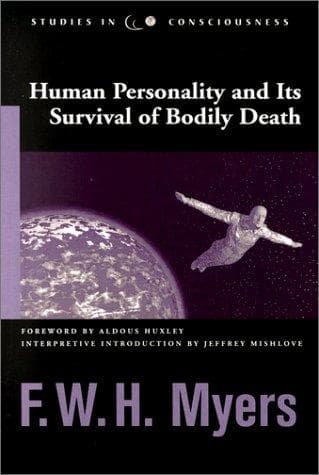
Human Personality and Its Survival of Bodily DeathMyers, F. W. H. (Frederic William Henry)
Religion
Human Personality and Its Survival of Bodily Death
Myers, F. W. H. (Frederic William Henry)
Immortality; Parapsychology; Personality
Here, then, let us pause and consider to what point the evidence
contained in this chapter has gradually led us. We shall perceive that
the motor phenomena have confirmed, and have also greatly extended, the
results to which the cognate sensory phenomena had already pointed. We
have already noted, in each of the two states of sleep and of waking,
the variously expanding capacities of the subliminal self. We have
watched a hyperæsthetic intensification of ordinary faculty,--leading up
to telæsthesia, and to telepathy, from the living and from the departed.
Along with these powers, which, on the hypothesis of the soul's
independent existence, are at least within our range of analogical
conception, we have noted also a precognitive capacity of a type which
no fact as yet known to science will help us to explain.
Proceeding to the study of motor automatisms, we have found a _third_
group of cases which independently confirm in each of these lines in
turn the results of our analysis of sensory automatisms both in sleep
and in waking. Evidence thus convergent will already need no ordinary
boldness of negative assumption if it is to be set aside. But motor
automatisms have taught us much more than this. At once more energetic
and more persistent than the sensory, they oblige us to face certain
problems which the lightness and fugitiveness of sensory impressions
allowed us in some measure to evade. Thus when we discussed the
mechanism (so to call it) of visual and auditory phantasms, two
competing conceptions presented themselves for our choice,--the
conception of _telepathic impact_, and the conception of _psychical
invasion_. Either (we said) there was an influence exerted by the agent
on the percipient's mind, which so stimulated the sensory tracts of his
brain that he externalised that impression as a quasi-percept, or else
the agent in some way modified an actual portion of space where (say) an
apparition was discerned, perhaps by several percipients at once.
Public-domain text, read in full here on John Shaqi.
Reviews
Reviews
No reviews yet
Be the first to share your thoughts on this work.
Elsewhere in the archive
Join the Discussion
Join the discussion
Sign in to leave a comment or review.
Sign InorCreate an account