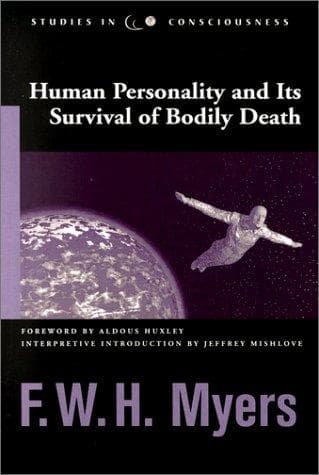
Human Personality and Its Survival of Bodily DeathMyers, F. W. H. (Frederic William Henry)
Religion
Human Personality and Its Survival of Bodily Death
Myers, F. W. H. (Frederic William Henry)
Immortality; Parapsychology; Personality
Similarly we find cases where the uprush of subliminal faculty is
concerned with the deep organic sensation of muscular resistance. We
need not postulate any direct or supernormal knowledge,--but merely a
subliminal calculation, such as we see in the case of "arithmetical
prodigies," expressing itself supraliminally, sometimes in a phantasmal
picture, sometimes as a mere "conviction," without sensory clothing.[31]
Passing on here to subliminal products of _visual_ type, I am glad to be
able to quote the following passage which seems to me to give in germ
the very theory for which I am now contending on the authority of one of
the most lucid thinkers of the last generation.
The passage occurs in an article by Sir John Herschel on "Sensorial
Vision," in his _Familiar Lectures on Scientific Subjects_, 1816. Sir
John describes some experiences of his own, "which consist in the
involuntary production of visual impressions, into which geometrical
regularity of form enters as the leading character, and that, under
circumstances which altogether preclude any explanation drawn from a
possible regularity of structure in the retina or the optic nerve."[32]
Twice these patterns appeared in waking daylight hours,--with no illness
or discomfort at the time or afterwards. More frequently they appeared
in darkness; but still while Sir John was fully awake. They appeared
also twice when he was placed under chloroform; "and I should observe
that I never lost my consciousness of being awake and in full
possession of my mind, though quite insensible to what was going on....
Now the question at once presents itself--What _are_ these Geometrical
Spectres? and how, and in what department of the bodily or mental
economy do they originate? They are evidently not dreams. The mind is
not dormant, but active and conscious of the direction of its thoughts;
while these things obtrude themselves on notice, and by calling
attention to them, _direct_ the train of thought into a channel it would
not have taken of itself.... If it be true that the conception of a
regular geometrical pattern implies the exercise of thought and
intelligence, it would almost seem that in such cases as those above
adduced we have evidence of a _thought_, an intelligence, working within
our own organisation distinct from that of our own personality." And Sir
John further suggests that these complex figures, entering the mind in
this apparently arbitrary fashion, throw light upon "the suggestive
principle" to which "we must look for much that is determinant and
decisive of our volition when carried into action." "It strikes me as
not by any means devoid of interest to contemplate cases where, in a
matter so entirely abstract, so completely devoid of any moral or
emotional bearing, as the production of a geometrical figure, we, as it
were, seize upon that principle in the very act, and in the performance
of its office."
Public-domain text, read in full here on John Shaqi.
Reviews
Reviews
No reviews yet
Be the first to share your thoughts on this work.
Elsewhere in the archive
Join the Discussion
Join the discussion
Sign in to leave a comment or review.
Sign InorCreate an account