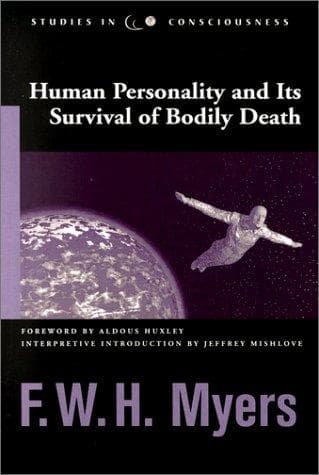
Human Personality and Its Survival of Bodily DeathMyers, F. W. H. (Frederic William Henry)
Religion
Human Personality and Its Survival of Bodily Death
Myers, F. W. H. (Frederic William Henry)
Immortality; Parapsychology; Personality
From my point of view, of course, I can but admire the acumen which
enabled this great thinker to pierce to the root of the matter by the
aid of so few observations. He does not seem to have perceived the
connection between these "schematic phantasms," to borrow a phrase from
Professor Ladd,[33] and the hallucinatory figures of men or animals seen
in health or in disease. But even from his scanty data his inference
seems to me irresistible;--"we have evidence of a _thought_, an
intelligence, working within our own organisation, distinct from that of
our own personality." I shall venture to claim him as the first
originator of the theory to which the far fuller evidence now accessible
had independently led myself.
Cases observed as definitely as those just quoted are few in number; and
I must pass on into a much trodden--even a confusedly
trampled--field;--the records, namely, left by eminent men as to the
element of subconscious mentation, which was involved in their best
work. Most of these stories have been again and again repeated;--and
they have been collected on a large scale in a celebrated work,--to me
especially distasteful, as containing what seems to me the loose and
extravagant parody of important truth. It is not my business here to
criticise Dr. Von Hartmann's _Philosophy of the Unconscious_ in detail;
but I prefer to direct my readers' attention to a much more modest
volume, in which a young physician has put together the results of a
direct inquiry addressed to some Frenchmen of distinction as to their
methods especially of imaginative work.[34] I quote a few of the replies
addressed to him, beginning with some words from M. Sully Prudhomme,--at
once psychologist and poet,--who is here speaking of the subconscious
clarification of a chain of abstract reasoning. "I have sometimes
suddenly understood a geometrical demonstration made to me a year
previously without having in any way directed thereto my attention or
will. It seemed that the mere spontaneous ripening of the conceptions
which the lectures had implanted in my brain had brought about within me
this novel grasp of the proof."
With this we may compare a statement of Arago's--"Instead of obstinately
endeavouring to understand a proposition at once, I would admit its
truth provisionally;--and next day I would be astonished at
understanding thoroughly that which seemed all dark before."
Condillac similarly speaks of finding an incomplete piece of work
finished next day in his head.
Somewhat similarly, though in another field, M. Retté, a poet, tells Dr.
Chabaneix that he falls asleep in the middle of an unfinished stanza,
and when thinking of it again in the morning finds it completed. And M.
Vincent d'Indy, a musical composer, says that he often has on waking a
fugitive glimpse of a musical effect which (like the memory of a dream)
needs a strong immediate concentration of mind to keep it from
vanishing.
Public-domain text, read in full here on John Shaqi.
Reviews
Reviews
No reviews yet
Be the first to share your thoughts on this work.
Elsewhere in the archive
Join the Discussion
Join the discussion
Sign in to leave a comment or review.
Sign InorCreate an account