Immediately we are most grateful to the participants in the six
humanistic nursing courses taught here at the Northport VAH. As nurses,
they received and accepted our expressed ideas to the extent of testing
them in the fires of their real lived nursing practice settings. While
struggling with our ideas and us, they gave to us. They were supportive,
loving, and truly present with us in the community of nurses at
Northport, VAH. Miss Sue McCann, clinical nurse specialist, one of our
first course participants, has read and reviewed our materials. More
than this Miss McCann has been a counselor, resource person, and a
dependable friend in our humanistic nursing effort of the last three
years. We hope our chapters give back to others, at least just a part
of what we have received from them in our travels in the nursing world.
J.G.P
L.T.Z.
[Transcriber's Note: to the 1988 Edition
Italic text has been marked as _text_.
Bold text has been marked as ~text~.
Obvious punctuation errors in the original have been corrected.
Other corrections are noted at the end of the text.
The original page numbers have been retained, e.g. {1} marks the start
of page 1 in the original text.]
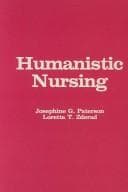
HUMANISTIC NURSING
_Josephine G. Paterson, DNSc, RN_
_Loretta T. Zderad, PhD, RN_
PREFACE
Somewhere there's a child a crying
Crying for freedom in South Africa.[1]
But until someone hears the cry and responds, the child will continue to
suffer the oppression of the current South African regime; and the world
will continue to be less than it could be. To cry aloud when there seems
no chance of being heard, belies a hope--perhaps an inherently human
trait--that someone, somewhere, somehow will hear that cry and respond
to it.
This same hope, that someone would hear and respond, allowed existential
psychologist Viktor Frankl to survive the systematic torture and
degradation in Nazi death camps. As Frankl and others sought their way,
they found meaning and salvation "through love and in love;" and by
choosing to believe that "life still waited for him, that a human being
waited for his return."[2]
There is power in the call of one person and the potential response of
another; and incredible power when the potential response becomes real.
There is the power for each person to change as she becomes more than
she was before the dialogue. There is the power to transcend the
situation as two people engage the events that are whirling around them
and together try to make sense of their worlds and find a meaning to
their existence. When the call and response between two people is as
honest as it can be, there is the revolutionary power which the poet
Muriel Rukeyser speaks of:
What would happen if one woman told the truth about her life?
The world would split open.[3]
{iv}
Public-domain text, read in full here on John Shaqi.
Reviews
Reviews
No reviews yet
Be the first to share your thoughts on this work.
Join the Discussion
Join the discussion
Sign in to leave a comment or review.
Sign InorCreate an account