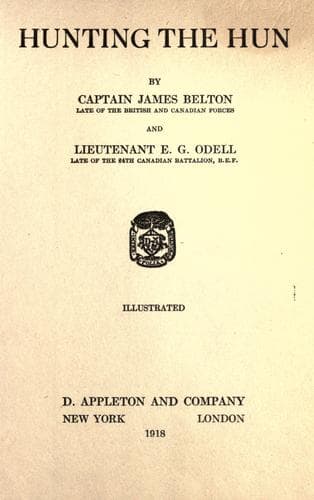
World War, 1914-1918 -- Personal narratives, Canadian
We were a very merry group, everyone in excellent spirits, which
reminded me of a little song that we all hum in France: "A Merry Life,
but a Short One." Two of the very officers who dined at our mess were
killed at Vimy Ridge on April 9th.
The following morning at 9 A.M., "A" Company was drawn up in close
column of platoons, in fighting order, ready for company inspection. It
was raining slightly and very muddy underfoot. The men were equipped as
they would be to go "over the top."
Only three platoons were drawn up for company inspection. It is
customary for one platoon per company, each in its turn, to remain out
of the line. These platoons with their officers form the nucleus of
a new battalion in case the battalion meets with heavy losses while
in the trenches. They may also be called upon to reinforce their
respective companies in the line.
After each platoon had been carefully inspected by their respective
platoon commanders, and then by the company commander, we were marched
off to our training ground, a distance of one kilometre, where there
was an extensive stretch of open ground.
When we reached our training area, we saw hundreds of yards of white
tapes two inches wide, stretched out before us. These tapes represented
to us the outline of the German trenches which we were to attack and
capture on Vimy Ridge. They lay on the ground in exactly the same
position that we would later find the German trenches.
A tape was laid to represent our battalion jumping-off trench. When I
reached my platoon's position in the jumping-off trench I halted and
formed line. We were then supposed to be in a shallow trench, two and
one-half feet wide by four feet deep. For practice purposes the "Zero
Hour" was ten A.M. A few minutes before ten o'clock, a runner (this is
a man whose special duty is to carry messages) gave me a message from
my company commander that we would make the practice attack and go
"over the top" at two minutes past "Zero Hour"--that is, two minutes
past ten o'clock.
Our artillery was to lay a barrage on the first line of presumed German
trenches at the same moment. A barrage is simply a moving wall of shell
fire, which precedes the troops, who advance beneath the trajectory
of the shells. We were to keep within fifty yards of our barrage in
diamond formation. This barrage was indicated by men on the right and
left flanks of our battalion frontage, which was a lateral distance of
335 yards.
Our battalion furnished four waves, each wave having its own mission to
accomplish--the whole battalion having one final objective.
Men with flags would continue waving them until the barrage was
supposed to lift, then they would double forward and indicate by their
flags where the barrage was then falling.
Public-domain text, read in full here on John Shaqi.
Reviews
Reviews
No reviews yet
Be the first to share your thoughts on this work.
Join the Discussion
Join the discussion
Sign in to leave a comment or review.
Sign InorCreate an account