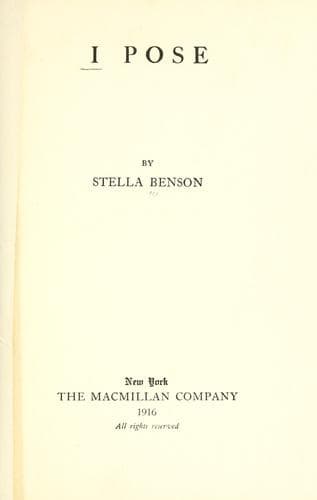
London (England) -- Fiction; Satire; Suffragists -- Fiction
Presently the suffragette said: “Can you imagine what you feel like if
you had been running in a race, and you had believed you were winning.
The rest were miles behind wasting their breath variously; and then
suddenly your eyes were opened, and you saw that you had been running
outside the ropes of the course, for you were never given the chance to
enter for the competition.”
“Good,” said the gardener enthusiastically. “So you’re tired of running
to no purpose, and you’re coming back to the starting-place to begin
again.”
“No,” said the suffragette, as firmly as though she had the muscular
supremacy and could start back that moment to pit her three matches
against the gods. “Never. There’s no such thing as running to no
purpose. It’s excellent exercise—running, but I’ll never run with the
crowd. There are much better things than winning the prize. There’s more
of everything out here—more air, more light, more comedy, more tragedy.
Also I get there first, you know. When you get the law-abider and the
church-goer in a crowd, they increase its moral tone, but they lessen
its power of covering the ground.”
“Personally I never was inside,” said the gardener, who had a natural
preference for talking about himself. “But then I am building a path of
my own.”
“Anyway, what did you mean originally?”
The gardener blushed again. He showered reproaches on himself. “Only
that we might walk into Southampton as friends. And if we liked it....
Besides I owe you a shilling, and you’d better keep an eye on your
financial interests. My boat sails to-morrow. You know, it is a nice
shock to me to find that a militant suffragette is human at all. When I
held your arm, I was surprised to find it was not iron.”
“Did you say your boat sailed to-morrow?”
“I should have said, ‘Our boat sails to-morrow.’”
“There’s no time to walk. We’ll hire a car in Aldershot.”
So at sunset, side by side, they arrived in sight of Southampton’s
useful but hackneyed sheet of water.
Even then they had no plans. In youth one likes the feeling of standing
on empty air with a blank in front of one.
The suffragette paid for the car without question. “I am quite well
off,” she excused herself, as they traversed the smug and comfortless
suburbs of the town. “Has that shilling I lent you to invest brought in
any interest?”
“I hate money,” posed the gardener; “but I have a profession, you know.
I am a gardener.”
“And where is your garden?”
“I have two. This is one”—and he held up Hilda, who was looking rather
round-shouldered owing to the exertions and emotions of the day—“and the
world is the other. It also happens that I have had three months’
training in a horticultural college.”
Public-domain text, read in full here on John Shaqi.
Reviews
Reviews
No reviews yet
Be the first to share your thoughts on this work.
Join the Discussion
Join the discussion
Sign in to leave a comment or review.
Sign InorCreate an account