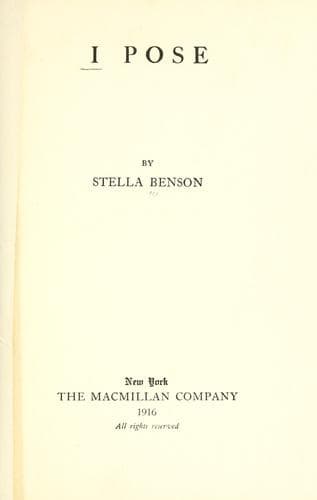
London (England) -- Fiction; Satire; Suffragists -- Fiction
“You don’t. I mean that I am a man, and I am not going to let you go,
because you must come with me to the uttermost ends of the earth.”
“Why?”
“Because I love the shape of your face, you dear little thing.”
The gods should not be disturbed. Also there was something very potent
in the impotent trembling of her arm.
There was an unnaturally long pause. Then she turned round.
“Let us discuss this matter,” she said, and gave him her portmanteau to
carry. The gardener loosed her arm and walked beside her. Silence and a
distance of a yard and a half were maintained between them for some way.
The gardener was gazing in blank astonishment at that ass, the gardener
of three minutes ago. Into what foolery had he not plunged?
If I could always be the Woman I Am, I should be a most rational and
successful creature. It is the Woman I Was who makes a fool of me, and
leaves me nervous as to the possible behaviour of the Woman I Shall Be.
There was something in the way the suffragette’s neck slipped loosely
into her collar which took a little of the sting out of the gardener’s
regrets. But the little plain eyes of her, and the aggressive manners of
her, and the misguided morals of her—that was the sequence in which the
gardener’s thoughts fell into line.
As for the suffragette, her heart, in defiance of anatomy, had gone to
her head, and was thundering rhythmically there. She was despising
herself passionately, and congratulating herself passionately. How
grand—she thought: how contemptible—she thought. For she was a world’s
worker, a wronged unit seeking rights, a co-heritor of the splendour of
the earth, a challenger, a warrior. And now, quite suddenly, she
discovered a fact the existence of which she had seldom, even in weak
moments, suspected. She found that—taken off her guard—she was a young
woman of six-and-twenty.
“How laughable,” she thought—and did not laugh—“I’m as bad as the ‘Oh my
dear’ girls.”
“Now,” she said at last, “what did you mean by that?”
“Only that you look like a good friend,” replied the gardener, who, poor
vagabond, was blushing furiously. “Mightn’t we be friends?”
“I am a friend to women,” said the suffragette slowly. “I’m a lover of
women. But never of men. I wouldn’t stir an inch out of my way for a
man. Unless I wanted to.”
“And do you want to?”
She looked at the gardener’s profile with the eyes of the newly
discovered young woman of six-and-twenty. Hitherto she had seen him only
with the militant eyes of armed neutrality. She looked at the rather
pleasing restlessness of his eyes, and the high tilt of his head. His
eyes were not dark with meaning, as the eyes of heroes of novels should
be, they were light and quick. The black pupils looked out fierce and
sharp, like the pupils of a cat, which flash like black sparks out of
the twilight of its soul. The gardener’s eyes actually conveyed little,
but they looked like blinds, barely concealing something of great value.
Public-domain text, read in full here on John Shaqi.
Reviews
Reviews
No reviews yet
Be the first to share your thoughts on this work.
Join the Discussion
Join the discussion
Sign in to leave a comment or review.
Sign InorCreate an account