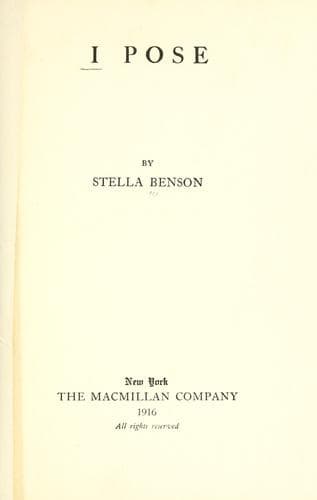
London (England) -- Fiction; Satire; Suffragists -- Fiction
Of a modest woman with a heavy jaw, the world would have said, “A dear
good creature, but dreadfully underhung.” Of a well-chinned woman with
dyed hair, it said, “There goes a strong character.” The hair did it,
and the hair was dyed by human agency. Providence had no hand in the
making of Mrs. Rust’s forcible reputation. Nowadays we leave it to our
dressmaker, and our manicurist, and our milliner, and our doctor, and
our vicar, to make us what we are. This is an age of luxury, and it is
so fatiguing to assert a home-made personality. Shall I go to my
hairdresser and say, “Here, take me, dye me heliotrope. Make an
influential woman of me”?
The gardener did not quail before the terrifying outer wall of Mrs.
Rust’s fortress. Believing as he did that man makes himself, and that
the pose of victor is as easy to assume as any other, he was unaware of
the reality of the word ‘defeat.’ Whether woman also makes herself, I
never fully understood from the gardener at this stage. But I gathered
that woman takes the rôles that man rejects.
The gardener, as a protégé of Mr. Abel, who, on the _Caribbeania_, was
respected because he was not personally known, found himself treated _à
la_ junior officer, streaked with a certain flavour of second-class
passenger, but distinctly suggesting ship’s orchestra. He was allowed to
have his meals in the first-class saloon, he was occasionally asked
about the weather by lady passengers, and the captain and officers
looked upon him good-naturedly, as a sort of example of poetic licence.
It seemed a good thing when dinner was over. One had proved one’s
courage, and the strain was past. The suffragette, who had given a proof
rather of obstinacy than of courage, retired weakly to her cabin. And
the gardener stood on deck and looked at the sea, while the moon
followed the ship’s course with her eyes. A table companion, an Anglican
priest, with a weak chin and piercing eyes, came and leaned upon the
rail at the gardener’s side.
“You smoke?” he asked, and you could hear that he was very conventional,
and that he believed that he was not.
A man-to-man sort of man.
“No,” said the gardener, and added, “I have no vices.”
He said this sort of thing simply to exasperate. The pose of
indifference to the world’s opinion is apt, sooner or later, to lead to
the pose of wilful pricking of the world’s good taste. The gardener had
a morbid craving for unpopularity; it was part of the unique pose.
Unpopularity is an excellent salve to the conscience; it is delicious to
be misunderstood.
The priest did not appear exasperated. He was tolerant. The man who aims
at unlimited tolerance, as a rule, only achieves the absorbent and
rather undecided status of spiritual blotting-paper. But he is a
dreadfully difficult man to anger.
Public-domain text, read in full here on John Shaqi.
Reviews
Reviews
No reviews yet
Be the first to share your thoughts on this work.
Join the Discussion
Join the discussion
Sign in to leave a comment or review.
Sign InorCreate an account