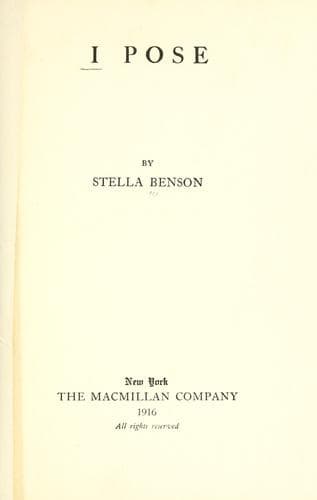
London (England) -- Fiction; Satire; Suffragists -- Fiction
In cubes of blue, in curves of mauve,
They spotted up my firmament;
And with my sharp grey heart I strove
To stab the colours as they went.
“Lou-_la_ ...” they said—“Lou-_la_, a thing
At war without a following.”
“Lou-_la_ ...” they cried—and now cry I—
“At war without an enemy....”
“I can’t think how you dare to speak out your imagination,” said the
suffragette. “Most people hide it like a sin.”
He was always willing to be the text of his own oratory.
“Imagination is my Genesis, and my Book of Revelations,” he answered.
“There is nothing with more power. It is stronger than faith, for it can
really move mountains. It has moved mountains, it has moved England from
my path and left me this clear sea.”
The suffragette walled herself more securely in. “I have no imagination
at all,” she lied, and then she added some truth: “I am very unhappy and
lonely.”
“The other day ...” said the gardener, “you were happy to be independent
and alone.”
“That’s why I’m now unhappy to be independent and alone. You can’t
discover the heaven in a thing without also tripping over the hell. I
like a black and white life.”
“Don’t think,” said the gardener suddenly, and almost turned the patting
of her knee into a slap. “It’s a thing that should only be done in
moderation. Some day you won’t be able to control your craving for
thought, and then you’ll die of Delirium Tremens.”
“It’s not such a dangerous drug as some,” smiled the suffragette. “I’d
rather have that craving than the drink craving, or the society craving,
or the love craving.”
“Better to have nothing you can’t control.”
“You hypocrite! You can’t control your imagination.”
“You’re right,” said the gardener after a pause. He was a curiously
honest opponent in argument. Besides, she had stopped crying, and there
was no special reason for continuing the discussion. Also Mrs. Paul Rust
at that moment appeared between the bay trees.
Mrs. Rust’s hair looked vicious in a garden, beside the geraniums, which
were at least sincere in colour, however blatant.
“Is this private?” she asked. There was something in the shy look of the
garden, and in the reproachful look of the gardener, that made the
question natural.
“No,” said the gardener. “This is the ship’s garden.”
“Good,” said Mrs. Paul Rust.
She always said “good” to everything she had not heard before. To her
the newest was of necessity the best. Originality was her ideal, and as
unattainable as most ideals are. For she was not in the least original
herself. She was doomed for ever to stand outside the door of her
temple. And “good” was her tribute of recognition to those who had free
passes into the temple. It owned that they had shown her something that
she would never have thought of for herself. For nothing had ever sprung
uniquely from her. Even in her son she could only claim half the
copyright.
Public-domain text, read in full here on John Shaqi.
Reviews
Reviews
No reviews yet
Be the first to share your thoughts on this work.
Join the Discussion
Join the discussion
Sign in to leave a comment or review.
Sign InorCreate an account