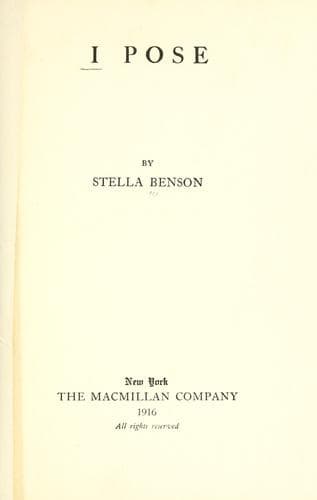
London (England) -- Fiction; Satire; Suffragists -- Fiction
On deck, a few enterprising spirits were playing deck quoits against the
elements. The general geniality whose rule only lasts for the first
three days of a voyage was reigning supreme. Young men were making
advances to young ladies with whom they would certainly quarrel in
forty-eight hours’ time, and young ladies were mocking behind their
hands at the young men they would be engaged to before land was reached.
The priest, with an appearance of sugared condescension, was showering
missiles upon the Bullboard as though they were blessings. (And they
were misdirected.) The inevitable gentleman who has crossed the Atlantic
thirty times and can play all known games with fatiguing perfection, was
straining like a greyhound on the leash towards the quoits which mere
amateurs were usurping. Captain Walters, who has a twin brother on every
liner that ever sailed, was brightly collecting signatures for a
petition to the Captain concerning a dance that very evening.
The gardener, with unusual cordiality, gave the reeling Courtesy his
arm, as they threaded the maze of amusements towards the garden.
There was only one deck-chair unoccupied. It was labelled loudly as
belonging to some one else, but Courtesy, always bold, even when
physically weakest, advanced straight upon it. It was next to the
suffragette’s. And the gardener became for the first time aware of a cat
in a bag, and of the fact that the cat was about to emerge.
The suffragette was the sort of person next to whom empty chairs are
always to be found. She had plenty to say, and what she said was often
rather amusing, but it was always a little too much to the point, and
the point was a little too sharp. She had a certain amount of small
talk, but no tiny talk. She was not so much ignored as avoided. She had
altogether missed youth, and its glorious power of being amused by what
is not, correctly speaking, amusing. Her generation thought her
“brainy,” it was very polite to her. Do you know the terrible sensation
of being invariably the last to be chosen at Nuts in May? This was the
suffragette’s atmosphere. My poor suffragette! It is so much more
difficult to bear the snub than the insult. Insult is like a bludgeon
thrown at the inflated balloon of our conceit. With the very blunt force
of it we rebound. But the snub is a pin-prick, which lets our supporting
pride out, and leaves us numb and nothing. I always feel the insult is
founded on passion, while the snub springs from innate dislike.
“May I introduce Miss Courtesy Briggs ...” began the gardener, hoping
for an inspiration before the end of the sentence. “Miss Courtesy
Briggs....”
Both women looked expectant.
“Miss Courtesy Briggs ... my wife.”
“O Lor’!” said Courtesy, and then, with her healthy regard for
conventions, remembered that this was not the proper retort to an
introduction.
“When you left Penny Street, a week ago ...” she said to the gardener,
as she shook the suffragette’s hand, “you didn’t tell me you were
engaged.”
Public-domain text, read in full here on John Shaqi.
Reviews
Reviews
No reviews yet
Be the first to share your thoughts on this work.
Join the Discussion
Join the discussion
Sign in to leave a comment or review.
Sign InorCreate an account