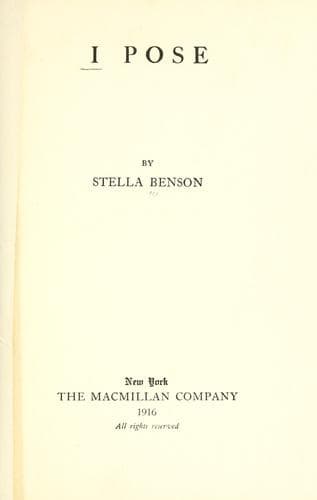
London (England) -- Fiction; Satire; Suffragists -- Fiction
In the distance, among her rows of empty chairs, the suffragette was
smiling. She had watched the dancing with that half-ashamed sort of
amusement which some of us feel when we see others making fools of
themselves. And because she smiled, the priest came and sat beside her.
He considered himself a temporary shepherd in charge of this maritime
flock, and you could see in his eye the craving for souls to save. He
had hardly noticed the suffragette until her smile caught his eye, but
directly he did notice her he saw that she was not among the saved. He
therefore approached her with the smile he reserved for the wicked.
“Very amusing, is it not?” he said.
Now the suffragette liked to see the young busy with their youth, but
because she was a snake she could not bear to say so. Especially in
answer to “Very amusing, is it not?”
So she said, “Is it?” and immediately cursed herself for the inhuman
remark. Some people’s humanity takes this tardy form of hidden
self-reproach after expression, and then it strikes inward, like
measles.
“Well, that’s as it may be, yerce, yerce,” said the priest, who was so
tolerant that he had no opinions of his own, and had hardly ever been
guilty of contradiction. “That is your husband, is it not?” he added, as
the gardener extricated himself from the knot of fallen dancers.
The suffragette actually hesitated, and then she said, “Yes,” and
narrowly escaped adding, “More or less.”
“A most interesting young man,” said the priest, who, with the keen eye
of the saver of souls, had noticed the hesitation.
“Naturally he interests me,” said the suffragette.
“He is so original,” continued the priest. “Even his occupation strikes
one as original. A gardener on an ocean liner. The march of science,
yerce, yerce. Most quaint. I suppose you also are interested in Nature.
I always think the care of flowers is an eminently suitable occupation
for ladies.”
“Perhaps,” she admitted. “But I am not a lady. I am a militant
suffragette.”
The priest’s smile changed from the saintly to the roguish. “Have you
any bombs or hatchets concealed about you?” he asked.
“I wish I had,” she replied. I fully admit that her manners were not her
strong point. But the priest persisted. He noted the absence of any
answering roguishness, and recorded the fact that she had no sense of
humour. True to his plastic nature, however, he said, “Of course I am
only too well aware of the justice of many of women’s demands, yerce,
yerce. But you, my dear young lady, you are as yet on the threshold of
life; it is written plain upon your face that you have not yet come into
contact with the realities of life.”
“In that case it’s a misprint,” said the suffragette. “I am twenty-six.”
“Twenty-six,” repeated the priest. “I wonder why you are bitter—at
twenty-six?”
“Because I have taken some trouble not to be sweet,” she said. “Because
I was not born blind.”
Public-domain text, read in full here on John Shaqi.
Reviews
Reviews
No reviews yet
Be the first to share your thoughts on this work.
Join the Discussion
Join the discussion
Sign in to leave a comment or review.
Sign InorCreate an account