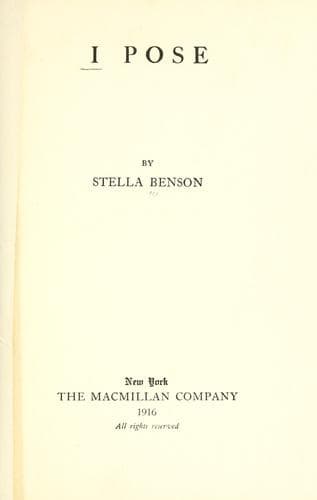
London (England) -- Fiction; Satire; Suffragists -- Fiction
Similes apart, however, the _Caribbeania_ was now so steady that an
infant could have danced a jig upon her deck. Several infants tried.
Amusements rushed upon her passengers from every side. A week passed
like a wink. Hardly were you awake in the morning before you found
yourself pursuing an egg round your own ankles with a teaspoon. Sports
and rumours of sports followed you even unto your nightly bunk.
Everybody developed talents hitherto successfully concealed in napkins.
Courtesy found her life’s vocation in dropping potatoes into buckets.
She brought this homely pursuit to a very subtle art, and felt that she
had not lived in vain. Not that she ever suffered from morbid illusions
as to her value. The gardener brought to light a latent gift for sitting
astride upon a spar while other men tried with bolsters to remove him.
The suffragette, when nobody was looking, acquired proficiency in the
art of shuffling the board. When observed, she instinctively donned an
appearance of contempt. Mrs. Paul Rust settled herself immovably in a
chair and applauded solo at the moments when others were not applauding.
The priest, looking in an opposite direction, clapped when he heard
other hands being clapped, in order to show the kind interest he took in
mundane affairs.
While occupied thus, one day, he found himself next to Courtesy. That
determined lady had her back to a Whisky and Soda Race then in progress,
and looked aggrieved. She had been beaten in the first heat, whereas she
was convinced that victory had been her due. Courtesy suffered from all
the faults that you and I—poetic souls—cannot love. She was greedy. She
was fat. She could not even lose a race without suspecting the
timekeeper of corruption. All the same, there was something so entirely
healthy and human about her, that nobody had ever pointed out to her her
lack of poetry, and of the more subtle virtues.
The priest, who had also never been able to lose a game without losing
his temper too, sympathised with Courtesy, and employed laborious tact
in trying to lead her thoughts elsewhere.
“Trinity Islands are your destination, are they not, yerce, yerce?” he
said.
“Yes,” replied Courtesy. “And I wish this old tub would buck up and get
there.”
“You have reasons of your own for being very anxious to arrive?”
suggested the priest archly.
“Nothing special that I know of,” answered Courtesy. “I’m only an
ordinary globe-trotter.”
Frankly, she was being sent out to get married. But this, of course, was
among the things that are not said. Her father had become tired of
supporting a daughter as determined to study art in London as she was
incapable of succeeding at it. He had accepted for her a casual
invitation from a cousin for a season in the Trinity Islands. The
invitation was so very casual that Courtesy had appreciated the whole
scheme as a matrimonial straw clutched at by an over-daughtered parent.
But her feelings were not hurt. She had bluff, tough feelings.
Public-domain text, read in full here on John Shaqi.
Reviews
Reviews
No reviews yet
Be the first to share your thoughts on this work.
Join the Discussion
Join the discussion
Sign in to leave a comment or review.
Sign InorCreate an account