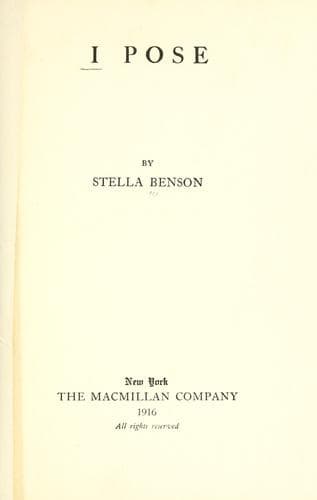
London (England) -- Fiction; Satire; Suffragists -- Fiction
“How curious that you should have found former friends on board!” said
the priest. “How small the world is, is it not?”
“Yes, isn’t it?” assented Courtesy, whose heart always warmed towards
familiar phrases. “And so odd, too, him being married within the week
like this.”
The priest pricked up his ears so sharply that you could almost hear
them click. “So quickly as that?” he encouraged her.
“Yes, when he left the private hotel where he and I were both staying
just over a fortnight ago, he was not even engaged. He says such quaint
things about it, too. He says he picked her up on the way to Paradise.”
The mention of Paradise confirmed the priest’s worst suspicions. But
“Yerce, yerce....” was his only reply to Courtesy.
Late that night the priest walked round and round the deck trying to
peer into the face of his god, professional duty. His conscience was as
short-sighted as some people’s eyes, and he was often known to pursue a
shadow under the impression that he was pursuing his duty.
“Of course I must warn the Captain,” he said. “And that bright young
lady who unconsciously gave me the news. And Mrs. Rust, who encourages
that misguided young man to talk. And Mrs. Cyrus Berry, who lets her
children play with him. As for the woman—I always think that women are
the most to blame in such cases.”
Although he was altogether narrow his limits were indefinite, except
under great provocation. He had not strength enough to draw the line
anywhere. “Wicked” was too big a word for him; and although he believed
that the gardener and the suffragette were in immediate danger of
hell-fire, he could only call them “misguided.” This applies to him only
in his capacity as a priest. In his own interests he was very much more
sensitive than he was in the interest of his God.
Sometimes I think that angels, grown old, turn into enemies to trap the
unwary. The angel of tolerance was the great saviour of history, but now
he saps the strength of every cause. Either I Am Right, or I May
Possibly Be Right. If I may only possibly be right, why should I dream
of burning at the stake for such a very illusory proposition? But if I
am right, then my enemy is Wrong, and is in danger of hell-fire. That is
my theory. My practice is to believe that belief is everything, and that
I may worship a Jove or a stone with advantage to my soul. Belief is
everything, and I believe. But if my enemy believes in nothing, then I
will condemn him. Why should I be tolerant of what I am convinced is
wrong?
Public-domain text, read in full here on John Shaqi.
Reviews
Reviews
No reviews yet
Be the first to share your thoughts on this work.
Join the Discussion
Join the discussion
Sign in to leave a comment or review.
Sign InorCreate an account