Hamilton, Ian, Sir, 1853-1947; South African War, 1899-1902
Produced by Al Haines.
[Illustration: Cover]
[Illustration: IAN HAMILTON. _From the Picture by_ John S. Sargent,
R.A.]
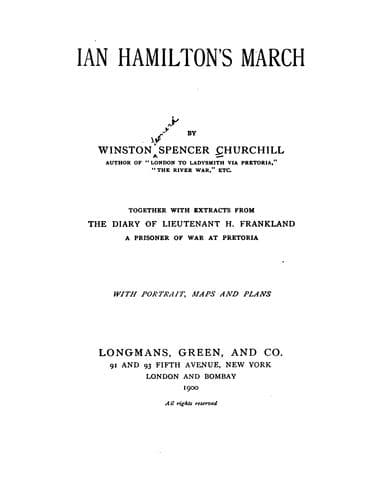
IAN HAMILTON’S MARCH
BY
WINSTON SPENCER CHURCHILL
_WITH PORTRAIT, MAPS AND PLANS_
TORONTO
THE COPP, CLARK COMPANY, LIMITED
COPYRIGHT, 1900, BY
WINSTON SPENCER CHURCHILL
_All rights reserved_
THIS COLLECTION OF LETTERS
IS INSCRIBED TO
LIEUT-GENERAL IAN HAMILTON, C.B., D.S.O.
WITH WHOSE MILITARY ACHIEVEMENTS
IT IS LARGELY CONCERNED
PREFACE.
This book is a continuation of those letters to the _Morning Post_
newspaper on the South African war, which have been lately published
under the title ’London to Ladysmith _via_ Pretoria.’ Although the
letters had been read to some extent in their serial form, their
reproduction in a book has been indulgently regarded by the public; and
I am encouraged to repeat the experiment.
The principal event with which the second series deals is the march of
Lieutenant-General Ian Hamilton’s column on the flank of Lord Roberts’s
main army from Bloemfontein to Pretoria. This force, which encountered
and overcame the brunt of the Boer resistance, which, far from the
railway, marched more than 400 miles through the most fertile parts of
the enemy’s country, which fought ten general actions and fourteen
smaller affairs, and captured five towns, was, owing to the difficulties
of telegraphing, scarcely attended by a single newspaper correspondent,
and accompanied continuously by none. Little has therefore been heard
of its fortunes, nor do I know of anyone who is likely to write an
account.
The letters now submitted to the public find in these facts their chief
claim to be reprinted. While written in the style of personal narrative
I have hitherto found it convenient to follow, they form a complete
record of the operations of the flank column from the day when Ian
Hamilton left Bloemfontein to attack the Waterworks position, until he
returned to Pretoria after the successful engagement of Diamond Hill.
Although in an account written mainly in the field, and immediately
after the actual events, there must be mistakes, no care has been spared
in the work. The whole book has been diligently revised. Four letters,
which our long marches did not allow me to finish while with the troops,
have been added and are now published for the first time. The rest have
been lengthened or corrected by the light of after-knowledge and
reflection, and although the epistolary form remains, I hope the
narrative will be found to be fairly consecutive.
Public-domain text, read in full here on John Shaqi.
Reviews
Reviews
No reviews yet
Be the first to share your thoughts on this work.
Join the Discussion
Join the discussion
Sign in to leave a comment or review.
Sign InorCreate an account