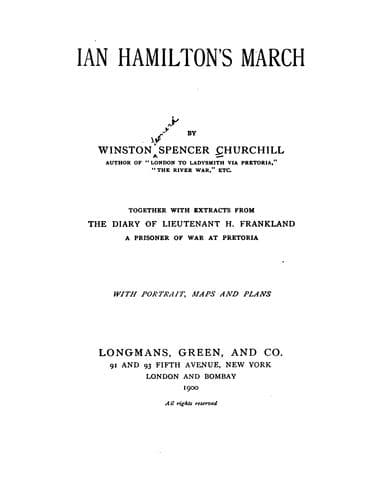
Hamilton, Ian, Sir, 1853-1947; South African War, 1899-1902
The conversation stops abruptly. Everyone looks round. Strolling
across the middle of the square, quite alone, was a very small
grey-haired gentleman, with extremely broad shoulders and a most
unbending back. He wore a staff cap with a broad red band and a heavy
gold-laced peak, brown riding boots, a tightly-fastened belt, and no
medals, orders, or insignia of any kind. But no one doubted his
identity for an instant, and I knew that I was looking at the Queen’s
greatest subject, the commander who had in the brief space of a month
revolutionised the fortunes of the war, had turned disaster into
victory, and something like despair into almost inordinate triumph.
Other soldiers of career and quality mingle with the diversified throng.
Macdonald sits on a bay pony near the club verandah talking to Martyr of
the Mounted Infantry and of Central African repute. Pole-Carew, who
came to the Cape as Sir Redvers Buller’s camp commandant, and passed at
a bound to brigadier-general, and by another still greater leap to the
command of the Eleventh Division, canters across the square. General
French and his staff have just ridden up. But the central figure holds
all eyes, and everyone knows that it is on him, and him alone, that the
public fortunes depend.
Such was the scene on the afternoon of my arrival in Bloemfontein. What
of the situation? The first thing to be done after the occupation of
the town was to re-open the railway. The presence of a large army in
their rear and the swift advance of Gatacre and Clements compelled the
invaders to withdraw from Cape Colony, so that Norval’s Pont and
Bethulie bridges were once more in British hands. Both were, however,
destroyed or partially destroyed. Besides these, various other smaller
bridges and culverts had been blown up. All these were forthwith
repaired by the engineers, and through communication by rail was
established between the advanced Field Army in the Free State and the
sea bases at East London, Port Elizabeth, and Capetown.
Public-domain text, read in full here on John Shaqi.
Reviews
Reviews
No reviews yet
Be the first to share your thoughts on this work.
Join the Discussion
Join the discussion
Sign in to leave a comment or review.
Sign InorCreate an account