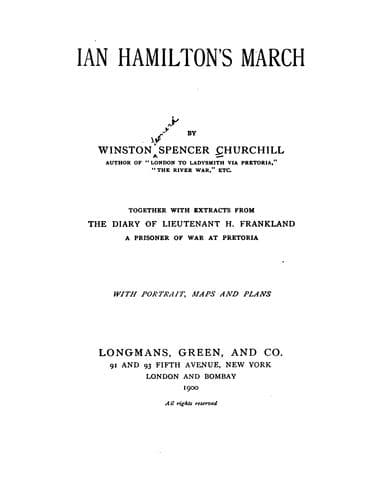
Hamilton, Ian, Sir, 1853-1947; South African War, 1899-1902
In the meantime the Army at Bloemfontein lived on the reserve of rations
it had carried from Modder River. When the railway was opened the line
from Modder River was dropped. A broad-gauge railway, even though it be
only a single line, is usually capable of supplying an army of at least
50,000 men with considerable ease, and the reader may remember how the
Natal Government Railway was able to support 30,000 men through January
and February, to transport reinforcements and sick, and to run all its
ordinary traffic in addition. But the repaired or provisional bridges
on the Bloemfontein line caused so much delay that the carrying power of
the railway was seriously diminished. When a permanent bridge has been
blown up two alternatives present themselves to the engineers: a high
level or a low level substitute. The high level bridge, such as was
thrown across the Tugela after the relief of Ladysmith, takes much
longer to build, but, when built, trains are run straight over it with
very little diminution of speed. It is, moreover, secure against
floods.
The low level bridge must be approached by zigzag ramps, which impose
frequent shuntings, and cause great delay; and it is, of course, only to
be trusted when there are no floods. But it has this inestimable
advantage in military operations: speed in construction. The Army must
be fed immediately. So the low level bridges were chosen; hence an
early but reduced supply. When this was further minimised by the
passage of reinforcements the commissariat depôts could scarcely make
headway, but must be content to feed the Army from day to day and
accumulate at the rate, perhaps, of only one day in three, or even one
in four. It was, therefore, evident that no offensive movement to the
northward could be made for several weeks.
See how the stomach governs the world. By the rapid invasion of their
territories, by the staggering blows which they had been dealt at
Kimberley, Paardeburg, Poplar Grove, and Dreifontein, and by the bad
news from Natal, the Boers in the Free State were demoralised. If we
could have pressed them unceasingly the whole country would have been
conquered to the Vaal River. Encouraged by Lord Roberts’s Proclamation,
and believing that all resistance in the Southern Republic was at an
end, great numbers of Free Staters returned to their homes, took the
oath of neutrality, and prepared to accept the inevitable.
But while the Army waited, as it was absolutely forced to wait, to get
supplies, to get horses--to get thousands of horses--to give the
Infantry new boots, and all arms a little breathing space, the Boers
recovered from their panic, pulled themselves together, and, for the
moment, boldly seized the offensive.
Public-domain text, read in full here on John Shaqi.
Reviews
Reviews
No reviews yet
Be the first to share your thoughts on this work.
Join the Discussion
Join the discussion
Sign in to leave a comment or review.
Sign InorCreate an account