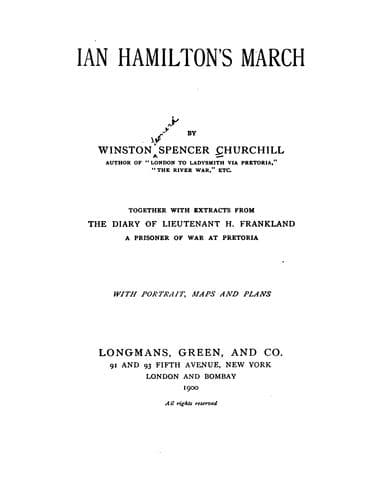
Hamilton, Ian, Sir, 1853-1947; South African War, 1899-1902
Great, though perhaps temporary, were the advantages which they gained.
The belief that the war in the Free State was at an end, which had led
so many of the Burghers to return to their farms, was shared to some
extent by the British commander, and loudly proclaimed by his colonial
advisers. To protect the farmers who had made their peace the Imperial
forces were widely extended. A line was drawn across the Free State
from Fourteen Streams, through Boshof, Bloemfontein, and Thabanchu,
south of which it was assumed that the country was pacified and
conquered.
Meanwhile Olivier and the southern commando, recalled from their
operations in the Cape Colony, were making a hurried, and, as it seemed,
a desperate march to rejoin the main Boer forces. They expected the
attack of the same terrible Army which had already devoured Cronje; nor
was it until they reached Ladybrand and found only Pilcher with a few
hundred men snapping at their heels that they realised that the bulk of
the British troops were for the moment practically immobile at
Bloemfontein. Then they turned.
Pilcher fled warily before them, and fell back on Broadwood’s Brigade,
near Thabanchu. With renewed courage and strong reinforcements from
their friends north of the line of occupation they pressed on. Broadwood
was compelled to fall back on the Ninth Division, which was camped west
of the waterworks. He made a twenty-mile march at night and laagered in
the small hours of the morning, thinking, as most people would think,
that pursuit was for the time being shaken off. Morning broke, and with
it a Boer cannonade.
I do not intend to be drawn into a detailed description of the action
that followed. For many reasons it deserves separate and detailed
consideration, chiefly because it shows the Boer at his very best:
crafty in war and, above all things, deadly cool. In a word, what
happened was this: The shells crashed into the laager. Everyone said,
’Take the blasted waggons out of the shell fire. We will cover their
retreat’; which they did most beautifully: Broadwood displaying all the
skill which had enabled him to disentangle the reconnaissance of the 5th
of April near the Atbara from the clutches of the Dervishes. The said
waggons hurried out of the shell fire only to fall into the frying-pan
of an ambuscade. Guns, prisoners, and much material fell into the hands
of the Boers. The Ninth Division retreated suddenly--too suddenly, say
the Army, with other remarks which it is not my business to
transcribe--on Bloemfontein, and the force of the storm fell on Gatacre.
Public-domain text, read in full here on John Shaqi.
Reviews
Reviews
No reviews yet
Be the first to share your thoughts on this work.
Join the Discussion
Join the discussion
Sign in to leave a comment or review.
Sign InorCreate an account