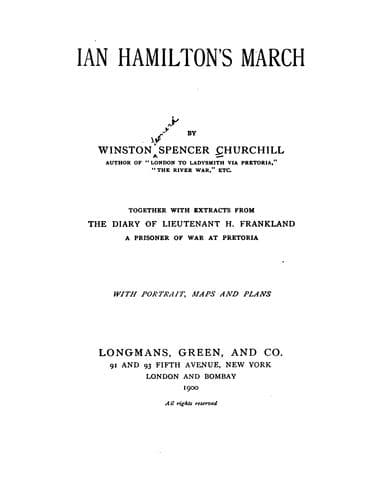
Hamilton, Ian, Sir, 1853-1947; South African War, 1899-1902
So far as could be learned the enemy had about seven thousand men with
twelve guns south of the Bloemfontein-Thabanchu line under Commandants
Olivier and De Wet, and with this force, which made up in enterprise and
activity what it lacked in numbers or material, they were attempting to
blockade and attack Wepener, to bar the road of Rundle’s column to
Dewetsdorp, and to check Brabant and Hart at Smithfield. Besides
proposing this ambitious programme, the Boers sent their patrols riding
about the country commandeering all pacified farmers under threats of
death.
* * * * *
We had a very pleasant ride from Reddersburg, and it was evening when we
rounded the shoulder of a grassy hill and saw the camp of the main
British column before us. It lay about the foot of a prominent knoll
rising from a broad plain, which was in striking contrast to the
mountains of Natal, and seemed to promise ample opportunity to the
regular soldier. ’Camp’ is, perhaps, an inaccurate description, for
there were scarcely any tents to be seen, and the rolling ground was
littered with swarms of grazing horses and oxen, and overspread with an
immense canopy of white smoke from the hundreds of gleaming grass fires
lighted to cook the soldiers’ suppers. I presented myself to Sir Leslie
Rundle, who received me courteously, and briefly explained the outlines
of the situation. We had arrived in the nick of time. The whole force
would march at dawn. The scouts had exchanged shots during the day.
The Kaffir spies reported that the enemy would fight on the morrow.
What could be better? So with much satisfaction we went to bed.
There was a biting chill in the air when the first light of dawn began
to grow in the sky, nor was I the only one who searched a modest kit for
some of those warm clothes which our friends at home have thoughtfully
been sending out. The South African winter was drawing near. But the
sun soon rose, and we shivered no longer. The Cavalry were early astir.
Indeed their mounted squadrons in silhouette against the morning sky was
my first waking impression, and by half-past five all were in motion. I
started a little later, but it was not long before I overtook them.
Though the command was not a large one it presented several interesting
features.
For the first time I saw the Imperial Yeomanry in the field. Trotting
across the beautiful green pasture land in a most extended formation, to
which they seemed readily to adapt themselves, were seven hundred
Yeomen, all good men and true, who had volunteered to fight because they
understood the main causes of the quarrel, and from personal conviction
earnestly desired to be of some assistance to the State, and who were,
moreover, excellently mounted on smart, short-docked cobs, which they
sat and rode like the sportsmen they mostly were.
Public-domain text, read in full here on John Shaqi.
Reviews
Reviews
No reviews yet
Be the first to share your thoughts on this work.
Join the Discussion
Join the discussion
Sign in to leave a comment or review.
Sign InorCreate an account