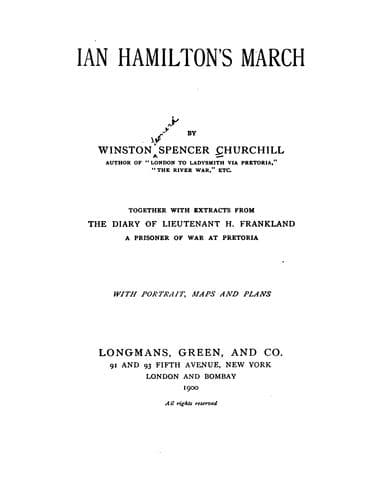
Hamilton, Ian, Sir, 1853-1947; South African War, 1899-1902
According to the best information there are three thousand Boers on the
Drakensburg Passes, and ten thousand on the Biggarsburg. Buller,
therefore, would have preferred to mask Van Reenen’s with the Ladysmith
Division (Fourth, Lyttelton), which was getting well and strong again,
and move northwards with the Second, Fifth, and Tenth Divisions. He did
not consider until northern Natal should be cleared that he could safely
move westward. On the other hand, the need in the Free State was urgent,
and it was therefore arranged that the Tenth Division (Hunter) should
come by sea to East London--one brigade to replace the division diverted
from Kimberley, one brigade to Bethulie, and that the rest of the Natal
Field Army should remain strictly on the defensive until the situation
was materially altered.
Practically, therefore, five brigades of troops were available for the
operations in the right-hand bottom corner: Hart, with a brigade of
Hunter’s Division at Bethulie, the Third and Eighth Divisions under
Chermside and Rundle at Springfontein and Bethany. Besides these
powerful bodies, which were quite independent of the communication
troops or the Bloemfontein Army, there were fourteen hundred Yeomanry
and Mounted Infantry under General Brabazon, and Brabant’s Colonial
Brigade, about two thousand five hundred strong.
It is scarcely necessary to follow all the movements in exact detail.
Rundle formed a column at Edenburg, and, marching to Reddersburg, joined
his force to part of Chermside’s Division from Bethany, thus having
under his immediate command eight battalions, four batteries, and
Brabazon’s Mounted Brigade. Another brigade was collecting at Edenburg
under Campbell. Hart was moved north-east towards Rouxville, where was
also Brabant with a thousand horse. The rest of Brabant’s force, some
fifteen hundred strong, were blockaded in Wepener by the enemy. Such
was the situation when I left Bloemfontein on the morning of the 17th.
I travelled prosperously; came by rail to Edenburg, trekked from there
in drenching rains, most unusual for this time of year, and greatly
increasing the difficulties of supply; and, resting for the night at
Reddersburg, caught up the marching column in its camp, about eleven
miles from Dewetsdorp, on the night of the 19th.
The position of the various troops was then as follows: Rundle, with
eight battalions, four batteries, and fifteen hundred horse at Oorlogs
Poorte, about twelve miles from Dewetsdorp; Campbell, with two
battalions and a battery near Rosendal, marching to join him; the
Grenadier Guards double marching through Reddersburg to catch up the
main force; Hart, with four battalions in Rouxville; Brabant, with one
thousand horsemen eight miles north of Rouxville; Dalgety, with a
garrison of fifteen hundred men, holding Wepener.
[Illustration: Operations in the O.F.S. April, 1900.]
Public-domain text, read in full here on John Shaqi.
Reviews
Reviews
No reviews yet
Be the first to share your thoughts on this work.
Join the Discussion
Join the discussion
Sign in to leave a comment or review.
Sign InorCreate an account