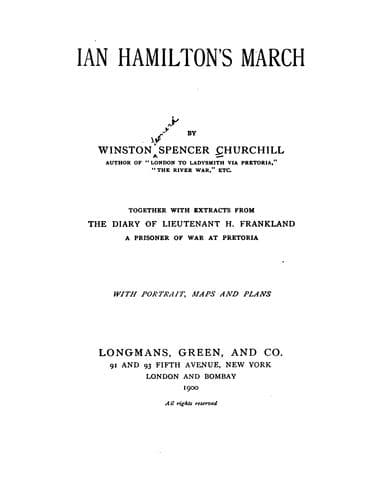
Hamilton, Ian, Sir, 1853-1947; South African War, 1899-1902
I knew every slope, every hillock and accident of ground, as one knows
men and women in the world. Here was good cover. There was a dangerous
space. Here it was wise to stoop, and there to run. Behind that steep
kopje a man might scorn the shrapnel. Those rocks gave sure protection
from the flanking rifle fire. Only a month ago how much these things
had meant. If we could carry that ridge it would command those
trenches, and that might mean the hill itself, and perhaps the hill
would lead to Ladysmith. Only a month ago these things meant honour or
shame, victory or defeat, life or death. An anxious Empire and a
waiting world wanted to know about every one of them--and now they were
precisely what I have said, dark jumbled mounds of stone and scrub, with
a few holes and crevices scratched in them, and a litter of tin-pots,
paper, and cartridge cases strewn about.
The train steamed cautiously over the temporary wooden bridge at Colenso
and ran into the open country beyond. On we hurried past the green
slope where poor Long’s artillery had been shot to bits, past Gun Hill,
whence the great naval guns had fired so often, through Chieveley Camp,
or rather through the site of Chieveley Camp, past the wreck of the
armoured train--still lying where we had dragged it with such labour and
peril, just clear of the line--through Frere and Estcourt, and so, after
seven hours’ journey, we came to Pietermaritzburg.
An officer who was travelling down with me pointed out the trenches on
the signal hill above the town.
’Seems queer,’ he said, ’to think that the Boers might so easily have
taken this town. When we dug those trenches they were expected every
day, and the Governor, who refused to leave the capital and was going to
stick it out with us, had his kit packed ready to come up into the
entrenchments at an hour’s notice.’
It was very pleasant to know that those dark and critical days were
gone, and that the armies in the field were strong enough to maintain
the Queen’s dominions against any further invasion; yet one could not
but recall with annoyance that the northern part of Natal was still in
the hands of the enemy. Not for long, however, shall this endure.
After waiting in Pietermaritzburg long enough only to dine, I proceeded
by the night train to Durban, and was here so fortunate as to find a
Union boat, the _Guelph_, leaving almost immediately for East London.
The weather was fine, the sea comparatively smooth, and the passengers
few and unobtrusive, so that the voyage, being short, might almost be
considered pleasant.
The captain took the greatest interest in the war, which he had followed
with attention, and with the details and incidents of which he was
extraordinarily familiar. He had brought out a ship full of Volunteers,
new drafts, and had much to say concerning the British soldier and his
comrades in arms.
Public-domain text, read in full here on John Shaqi.
Reviews
Reviews
No reviews yet
Be the first to share your thoughts on this work.
Join the Discussion
Join the discussion
Sign in to leave a comment or review.
Sign InorCreate an account