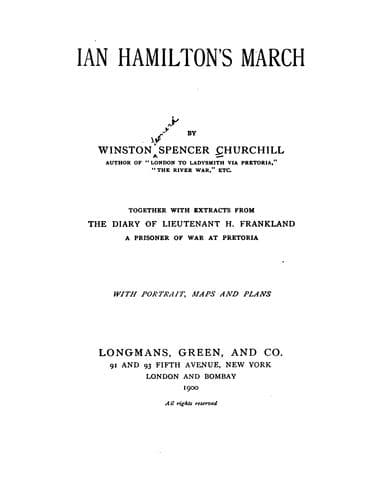
Hamilton, Ian, Sir, 1853-1947; South African War, 1899-1902
A few regulars--sunburnt men, who had fought their way in with
Buller--sauntered up to the trucks, and began a conversation with the
reinforcement. I caught a fragment: ’Cattle trucks, are they? Well,
they didn’t give us no blooming cattle trucks. No, no! We came into
Ladysmith in a first-class doubly extry Pullman car. ’Oo sent ’em?
Why, President ---- Kruger, of course,’ whereat there was much laughter.
I must explain that the epithet which the average soldier uses so often
as to make it perfectly meaningless, and which we conveniently express
by a ----, is always placed immediately before the noun it is intended
to qualify. For instance, no soldier would under any circumstances say
’---- Mr. Kruger has pursued a ---- reactionary policy,’ but ’Mr. ----
Kruger has pursued a reactionary ---- policy.’ Having once voyaged for
five days down the Nile in a sailing boat with a company of Grenadiers,
I have had the best opportunities for being acquainted with these
idiomatic constructions, and I insert this little note in case it may be
useful to some of our national poets and minstrels.
The train started across the well-known ground, and how fast and easily
it ran. Already we were bounding through the scrub in which a month
before Dundonald’s leading squadrons, galloping in with beating hearts,
had met the hungry picket line.
Intombi Spruit hospital camp was reached in a quarter of an hour.
Hospital camp no longer, thank goodness! Since the bridge had been
repaired the trains had been busy, and two days before I left the town
the last of the 2,500 sick had been moved down to the great hospital and
convalescent camps at Mooi River and Highlands, or on to the ships in
the Durban Harbour. Nothing remained behind but 100 tents and marquees,
a stack of iron cots, the cook houses, the drinking-water tanks, and 600
graves. Ghastly Intombi had faded into the past, as a nightmare flies
at the dawn of day.
We sped swiftly across the plain of Pieters, and I remembered how I had
toiled across it, some five months before, a miserable captive, casting
longing eyes at the Ladysmith balloon, and vigilantly guarded by the
Boer mounted escort. Then the train ran into the deep ravine between
Barton’s Hill and Railway Hill, the ravine the Cavalry had ’fanned’ on
the day of the battle, and, increasing its pace as we descended towards
the Tugela, carried us along the whole front of the Boer position. Signs
of the fighting appeared on every side. Biscuit tins flashed brightly
on the hill-side like heliographs. In places the slopes were
honey-combed with little stone walls and traverses, masking the
sheltering refuges of the Infantry battalions during the week they had
lain in the sun-blaze exposed to the cross-fire of gun and rifle. White
wooden crosses gleamed here and there among the thorn bushes. The dark
lines of the Boer trenches crowned the hills. The train swept by--and
that was all.
Public-domain text, read in full here on John Shaqi.
Reviews
Reviews
No reviews yet
Be the first to share your thoughts on this work.
Join the Discussion
Join the discussion
Sign in to leave a comment or review.
Sign InorCreate an account