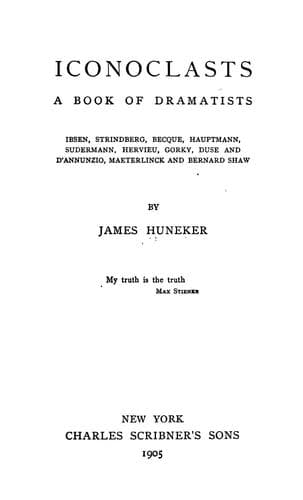
Iconoclasts: A Book of Dramatists: Ibsen, Strindberg, Becque, Hauptmann, Sudermann, Hervieu, Gorky, Duse and D'Annunzio, Maeterlinck and Bernard ShawHuneker, James
History
Iconoclasts: A Book of Dramatists: Ibsen, Strindberg, Becque, Hauptmann, Sudermann, Hervieu, Gorky, Duse and D'Annunzio, Maeterlinck and Bernard Shaw
Huneker, James
Dramatists; European drama -- 19th century -- History and criticism; European drama -- 20th century -- History and criticism
The reading of the play gives the impression of a melodramatic touch
in this catastrophe. It seems at first as if the author in despair
had solved his problem by a hasty theatrical stroke. As performed by
the inimitable Bartet and Le Bargy and Paul Mounet there is only a
faint suggestion of the theatric. Like the divorce theme, the tragedy
at the close is but an aid to expand M. Hervieu's thesis. Not the
inviolability of ecclesiastical marriage, not the dispute of two men
for the possession of a woman, but his thesis is the exposition of
the truth that a man and a woman are forever linked by that bond of
flesh, their child. Otherwise the dramatist holds no brief for heredity
or one against divorce. He selected his material like an artist.
What would have been the result if Marianne had had a child by her
second husband? Probably we should have had no play. We must accept
the premises of Hervieu or else avoid challenging his conclusions. In
the remotest analysis a drama may be an entity for the crucible of
the metaphysician; yet if it be great it will defy the test of logic
as does life itself. And there is not only logic in Paul Hervieu's
Le Dédale, but life, a great section of throbbing, real life. It is
certainly the most significant French play thus far of the new century.
I tested the validity of the foregoing criticism written after
reading the play by attending a performance at the Français, Paris,
October 20, 1904. Madame Bartet was superb, far exceeding my rather
suspicious expectations. Her serenity and dignity in the earlier acts;
the maternal anguish, the maternal--literally--passion that caused
her defection; the remorse and almost hysterical confession, were
all indicated by this mistress of fine nuances. Le Bargy has seldom
been better cast, while Paul Mounet was excellent; and I was almost
convinced by the finale, though I wish the playwright, taking a hint
from Ibsen, had ended on an unresolved cadence. But M. Hervieu is too
logical, too Gallic, to treat his audiences thus. He even re-wrote The
Enigma so as to make the end clearer.
The Enigma, which London saw in March, 1902, at Wyndham's Theatre, was
then called Cæsar's Wife, which is, as Osman Edwards justly remarks, a
pompous title.
Public-domain text, read in full here on John Shaqi.
Reviews
Reviews
No reviews yet
Be the first to share your thoughts on this work.
Elsewhere in the archive
Join the Discussion
Join the discussion
Sign in to leave a comment or review.
Sign InorCreate an account