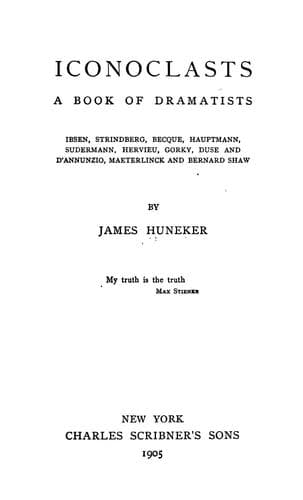
Iconoclasts: A Book of Dramatists: Ibsen, Strindberg, Becque, Hauptmann, Sudermann, Hervieu, Gorky, Duse and D'Annunzio, Maeterlinck and Bernard ShawHuneker, James
History
Iconoclasts: A Book of Dramatists: Ibsen, Strindberg, Becque, Hauptmann, Sudermann, Hervieu, Gorky, Duse and D'Annunzio, Maeterlinck and Bernard Shaw
Huneker, James
Dramatists; European drama -- 19th century -- History and criticism; European drama -- 20th century -- History and criticism
The English cast of L'Enigme was: Mrs. Tree as Léonore, Fay Davis as
Giselle, Fred Kerr as Marquis de Neste, Leonard Boyne as Vivarce. The
story is simple, the treatment rather classic: Act I is lengthy, barren
of incident, and bitter in its polemical tone; Act II is old-fashioned
in its development and climax, yet the last words spoken are distinctly
novel and a tremendous indictment of the man who slays the woman on
the plea of outraged honour. Here is Dumas's _Tué-là_ reversed with
a vengeance. Yet one platitude supplants another. If the brute who
kills his wife because she is unfaithful to him is to be succeeded by
the lady who deceives her husband because he is unpleasant to her,
where does the moral come in? It is a new convention driving out an
old. As Hervieu is _féministe_, his sympathy leads him to espouse the
cause of the woman. Without wishing to be ungallant, we may ask what
is the difference between the woman with a half-dozen lovers and the
man with a half-dozen mistresses? In the eyes of the law, in the eyes
of religion, none; in the eyes of society a vast deal--if the woman is
discovered. Not if the man is; but before a jury-box composed of twelve
intelligent men the woman who--as popular parlance has it--"sins" has
every chance of being pitied and pardoned. Here the elemental sympathy
of the male for the female counts heavily against testimony and judge's
charge.
Dumas knew this (if he had lived in America the fact would have been
driven home every morning in the newspapers) when he wrote Francillon,
especially when he wrote Femme de Claude. _Tué-là_! was his ferocious
advice. So M. Hervieu set himself to preach the contrary. In Les
Paroles Restent, his first dramatic essay, even in Les Tenailles,
and La Loi de l'Homme, the wordiness becomes most monotonous. In The
Enigma, we notice the same long-winded discussions à la Dumas as in
Princesse Georges, with the _raisonneur_ in the centre of the stage,
--in this case Marquis de Neste,--weighing the merits of the various
speeches, spouting many himself, altogether turning the expository
act into a debating society. In their revolt against the so-called
"well-made play," the newer Parisian dramatists have gone to the other
extreme.
Public-domain text, read in full here on John Shaqi.
Reviews
Reviews
No reviews yet
Be the first to share your thoughts on this work.
Elsewhere in the archive
Join the Discussion
Join the discussion
Sign in to leave a comment or review.
Sign InorCreate an account