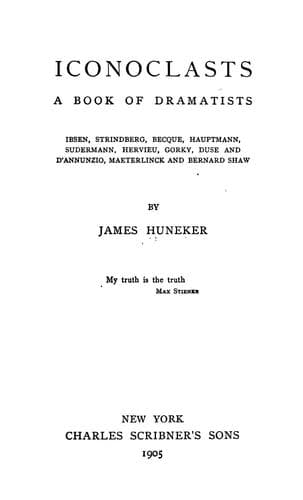
Iconoclasts: A Book of Dramatists: Ibsen, Strindberg, Becque, Hauptmann, Sudermann, Hervieu, Gorky, Duse and D'Annunzio, Maeterlinck and Bernard ShawHuneker, James
History
Iconoclasts: A Book of Dramatists: Ibsen, Strindberg, Becque, Hauptmann, Sudermann, Hervieu, Gorky, Duse and D'Annunzio, Maeterlinck and Bernard Shaw
Huneker, James
Dramatists; European drama -- 19th century -- History and criticism; European drama -- 20th century -- History and criticism
However, the plot of The Enigma is distinctly worth the telling. Two
brothers, noblemen, De Gourgiran by name, are married to two charming
women, Léonore and Giselle. Here is a quartet instead of the eternal
duo with the triangle hung over the door like a sinister horseshoe
presaging ill luck. To this double family are added the elderly
Marquis, who is a cousin to the brothers, and a young man, Vivarce
by name. He is the unknown quantity of this well-mixed combination.
At first the household seems like most happy ones--without anything
worthy of chronicling. The brothers are mighty Nimrods, the wives
have children to interest them, Vivarce to amuse them, the Marquis to
lecture them. Everything goes on oiled wheels until the gamekeeper of
the estate tells his masters that poachers are abroad. The fraternal
pair resolve on stealing out before daybreak and surprising the
rascals. The respective characters of the brothers do not show much
diversity; both live to hunt, and incidentally they love their wives
better, much better, than their dogs. About this there must be no
mistake. Honest, upright, inflexible, hard-hearted, hard-headed
persons, they are absolutely lacking in humour. They bore their
wives, and if you would tell them this, they would shrug shoulders
philosophically and remark that women, especially good wives, were
intended to be bored by husbands.
But note their scowling features if that drawing-room animal, the
professional lover, is mentioned! Both empty their choicest vials
of objurgation and fury upon the luckless beast's head. In fact, a
discussion is started about the treatment a man should accord an erring
wife. The one rather would shoot such a wife through the heart, the
other brother would slay the lover and keep the wife alive and near
at hand so that she might be tortured. This cold-blooded proposition
arouses the righteous indignation of Giselle, who protests in the name
of her sex, in the name of humanity. She becomes so agitated that the
Marquis, whose suspicions have been aroused for some time, suspects the
lady of carrying on an intrigue with Vivarce. Earlier in the scene he
has privately accused Vivarce of betraying one of his hosts' wives, but
which one he cannot say.
Public-domain text, read in full here on John Shaqi.
Reviews
Reviews
No reviews yet
Be the first to share your thoughts on this work.
Elsewhere in the archive
Join the Discussion
Join the discussion
Sign in to leave a comment or review.
Sign InorCreate an account