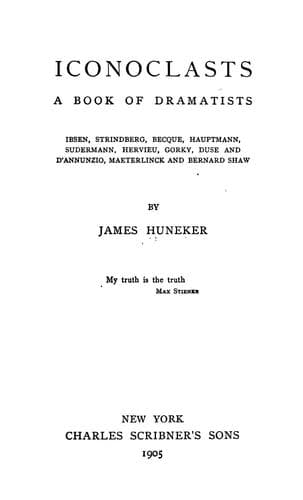
Iconoclasts: A Book of Dramatists: Ibsen, Strindberg, Becque, Hauptmann, Sudermann, Hervieu, Gorky, Duse and D'Annunzio, Maeterlinck and Bernard ShawHuneker, James
History
Iconoclasts: A Book of Dramatists: Ibsen, Strindberg, Becque, Hauptmann, Sudermann, Hervieu, Gorky, Duse and D'Annunzio, Maeterlinck and Bernard Shaw
Huneker, James
Dramatists; European drama -- 19th century -- History and criticism; European drama -- 20th century -- History and criticism
Now here is where the puzzle comes in and the psychology evaporates.
The Marquis, so he relates, while suffering from insomnia, gets up one
fine night and sees Vivarce vanishing in the door of the château, which
door was opened by a female hand. Whose? Evidently one of the married
women. Which one? Ah, that is the enigma! Vivarce feebly admits his
shameful behaviour, though he refuses to give the name of the fair
sinner. The old nobleman is perplexed. He advises flight. He talks like
an ancient uncle from the country, who does not wish to borrow money
from his city relatives--that is, he talks sense, and as it dribbles
in one ear and out the other of his moonstruck companion, he realizes
the futility of his well-meant sermon. Young men will be fools and
lunatics--and he might have added, when they are not, heaven help their
wives in later years!
Unknown to the others the brothers resolve on lying in wait for the
poachers. After some conjugal bantering they retire. Their wives sit
up to talk matters over. The door has been barred; it is very close
within; Giselle proposes that they open the house. She essays in vain
to lift the heavy oaken bar. Leonore tries. She succeeds. The moonlight
is mellow without, and the summer night sends pleasant air and odours
into the living room. At last the two women prepare for bed. Novels
are selected, and with lamps in hand they are leaving the room without
thought of the open door. Giselle remembers it and returns. Leonore
bids her not to bother--there are no thieves in the neighbourhood. The
curtain falls.
Up to this moment there is no way of recognizing the "guilty" woman.
Dishonours are about even. Giselle, to be sure, is passionate in her
protestations of contempt for the brutality of husbands who take the
law into their own hands. But Leonore unbars the door. Giselle recalls
the fact that it should not be open, and Leonore tells her not to
worry. Which one is it? And before you rush rashly to a conclusion
remember that the dramatist knows more than his audience, and that he
contrives pitfalls for the unwary. Both women seem guilty, both may be
innocent. One of the brothers comes softly into the room; both have
agreed not to worry their wives about the poachers. The door is found
unbolted. The first comer surmises that his brother has preceded him,
but the gamekeeper tells him the door was open. Then the other brother
enters. Surprise! But there is no time for this sentiment, as a man
steals through the dimly lighted room. After a brief, fierce struggle
he is pinioned. A lantern reveals the features of Vivarce. How did he
come there? Why did he come out of the women's apartments at this hour
in the morning? Hate and destruction are in the air.
Public-domain text, read in full here on John Shaqi.
Reviews
Reviews
No reviews yet
Be the first to share your thoughts on this work.
Elsewhere in the archive
Join the Discussion
Join the discussion
Sign in to leave a comment or review.
Sign InorCreate an account