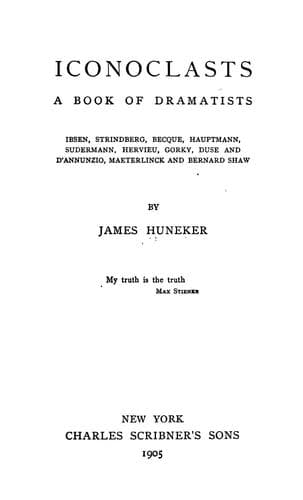
Iconoclasts: A Book of Dramatists: Ibsen, Strindberg, Becque, Hauptmann, Sudermann, Hervieu, Gorky, Duse and D'Annunzio, Maeterlinck and Bernard ShawHuneker, James
History
Iconoclasts: A Book of Dramatists: Ibsen, Strindberg, Becque, Hauptmann, Sudermann, Hervieu, Gorky, Duse and D'Annunzio, Maeterlinck and Bernard Shaw
Huneker, James
Dramatists; European drama -- 19th century -- History and criticism; European drama -- 20th century -- History and criticism
His answers are evasive. He is nervous--wanted a cigarette. The lie is
cast back in his teeth. And then a woman, holding a candle, rushes in
with pale face. It is Leonore. She has been awakened, so she avers,
by the shock of voices. Her husband sternly inquires her whereabouts
a few moments before. She has an excuse ready. She swears she is not
guilty, and even kneels to Vivarce, beseeching him to clear her. It is
too much. Her husband plucks her by the arm, and then, as his brother
questions her too closely, the man wavers to the side of his wife.
Perhaps, after all, it was Giselle. Yes, where is Giselle? The husband
of the absent one is swift to defend her. He goes to her room and
finds her fast asleep. Aha! says the other woman, and awakens her.
Confused by the lights, the accusation, the clash of words, she is the
very picture of a guilty woman as she enters in her white night robe,
her hair unbound, her features suffused in tears. Besides, did she not
make some very audacious speeches earlier in the evening defending the
right to love of a woman wearied of her husband? Free love--ah, odious
phrase! It damns her at once.
The trouble with a situation of this kind is that the spectator,
carried away by his curiosity, forgets all about the play of character,
the problem involved. It is The Lady or the Tiger over again, and
not so cleverly handled as that little masterpiece, for, as we shall
presently see, Hervieu solves the riddle in a very prosaic fashion.
A big interrogation point at the end would be the only excuse for
a recrudescence of a play of the Dumas sort. When Richard Strauss
composed the enigmatic tonalities at the close of his Tone poem, Also
Sprach Zarathustra, he did so because he could not logically leave
us on a full harmonic close. Since Hervieu did not develop his theme
broadly and allowed it to degenerate into the theatric device of
guessing the girl, he might have followed Frank Stockton and Richard
Strauss--withheld the complete dénouement and sent us home wondering.
But his artistic conscience began to operate at the close of Act II,
and not daring in Act III, he despatches his young lover out to the
dewy morn, there to shoot himself. This suicide cuts the tangle.
The sister who quails at the news is the guilty one--a Solomon-like
judgment, if ever there was one.
The gunshot rouses the women. Leonore it is who shudders and screams;
Giselle is only shocked. The complacent face of her husband at this
juncture is a study in selfishness. Leonore's husband throttles her and
is pulled off just in time. He bids her live--he knows how to torture;
and as the curtain falls the Marquis in the centre of the picture
invokes the curse of heaven on a social system that tolerates such
hideous cruelty.
Public-domain text, read in full here on John Shaqi.
Reviews
Reviews
No reviews yet
Be the first to share your thoughts on this work.
Elsewhere in the archive
Join the Discussion
Join the discussion
Sign in to leave a comment or review.
Sign InorCreate an account