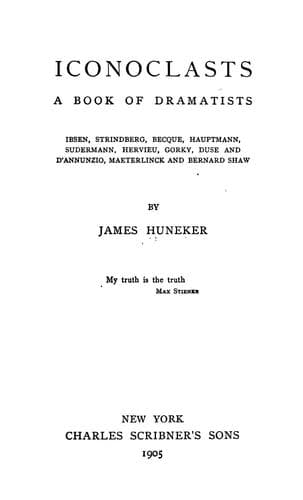
Iconoclasts: A Book of Dramatists: Ibsen, Strindberg, Becque, Hauptmann, Sudermann, Hervieu, Gorky, Duse and D'Annunzio, Maeterlinck and Bernard ShawHuneker, James
History
Iconoclasts: A Book of Dramatists: Ibsen, Strindberg, Becque, Hauptmann, Sudermann, Hervieu, Gorky, Duse and D'Annunzio, Maeterlinck and Bernard Shaw
Huneker, James
Dramatists; European drama -- 19th century -- History and criticism; European drama -- 20th century -- History and criticism
It may be seen that the intellectual playwright takes advantage of a
situation in Pagliacci or in Catulle Mendès's La Femme de Tabarin; when
the lover is being killed or is killed, the grief of the "guilty" wife
betrays her secret to the world. It is lacking in novelty, yet a sound
situation psychologically. The torture motive is not new.
However, Paul Hervieu's reputation does not stand or fall on this drama
any more than it does on his novels, Flirt and L'Armature. Les Paroles
Restent has a theme cleverly invented, above all cleverly handled.
A man sets in motion a lie about a young girl in society, though he
believes it is the truth. Later he meets and loves her. His remorse is
great when he discovers that she is innocent. To make reparation (oh,
masculine vanity of vanities!) he resolves to confess both his love and
his fault. He does so. The woman, Régine de Vesles, is outraged in her
pride, in her love, to discover that her secret calumniator is the man
she has adored. She parts from him. A duel is precipitated--lugged in
by the hair, really--and De Nohan is dangerously wounded. Naturally
Régine goes to his bedside and pardons him. They are sure to be happy.
Alas! _les paroles restent_, and after De Nohan hears repeated his
vile slander he dies. The situations are effective throughout, the
character-drawing subtle.
This play is full of melodrama, and, as has been pointed out, contains
"several weapons borrowed from the arsenal of the inexhaustible
Scribe." Hervieu followed it with Les Tenailles, which was at
once a challenge to his critic and a greater play. _Tenailles_
(nippers)--horrible word! Here the author gives us human nature in the
raw. A woman is married to a man she does not love. He, it appears,
makes no attempt to secure her love. She really loves a famous man,
a traveller. She tells her husband so. She will not deceive him, as
other feebler women would; she must leave at once. But the husband
of Irene Fergan is cool-headed. He asks his wife how she proposes to
escape the hateful marriage tie. She must give the law a reason, a
motive. Collusion is the only remedy, and he will not enter into any
such conspiracy. Then she declares she will run away. Not far, he
calmly replies, for there is always the police. No matter what she
does, he will not let her go. Bowing her head, the woman submits. The
wife is the prisoner of the husband, the woman bond-slave of the man,
despite all our gabbling about emancipation and equal rights in this
enlightened century.
Public-domain text, read in full here on John Shaqi.
Reviews
Reviews
No reviews yet
Be the first to share your thoughts on this work.
Elsewhere in the archive
Join the Discussion
Join the discussion
Sign in to leave a comment or review.
Sign InorCreate an account