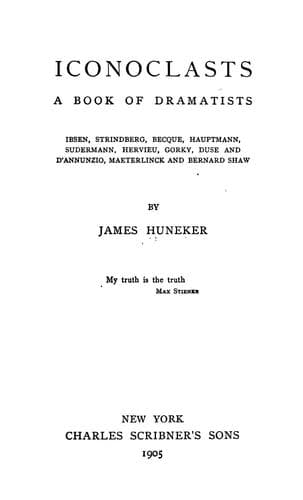
Iconoclasts: A Book of Dramatists: Ibsen, Strindberg, Becque, Hauptmann, Sudermann, Hervieu, Gorky, Duse and D'Annunzio, Maeterlinck and Bernard ShawHuneker, James
History
Iconoclasts: A Book of Dramatists: Ibsen, Strindberg, Becque, Hauptmann, Sudermann, Hervieu, Gorky, Duse and D'Annunzio, Maeterlinck and Bernard Shaw
Huneker, James
Dramatists; European drama -- 19th century -- History and criticism; European drama -- 20th century -- History and criticism
It is easy to praise Mozart to-day; not so easy to demonstrate the
genius of Richard Strauss. Wagner in 1888 was still a bogie-man, a
horrid hobgoblin threatening the peace of academic British music. Shaw
took up the fight, just as he fought for Degas and Manet when he was an
art critic. I still preserve with reverence his sweeping answer to Max
Nordau. It wiped Nordau off the field of discussion.
And the plays! They, too, are controversial. They all prove something,
and prove it so hard that presently the play is swallowed up by its
thesis--the horse patiently follows the cart It may not be art, but
it is magnificent Shaw. You can skip the plays, not the prefaces.
Widowers' Houses is the most unpleasant, ugly, damnably perverse of the
ten. The writer had read Ibsen's An Enemy of the People too closely.
Its drainpipes, and not its glorification of the individual, got into
his brain. It filtered forth bereft of its strength and meaning in this
piece, with its nasty people, its stupidities. How could Shaw be so
philistine, so much like a vestryman interested in pauper lodgings? In
the implacable grasp of Ibsen, this sordid theme would have been beaten
on a red-hot anvil until shaped to something of purpose and power.
Shaw was not blacksmith enough to swing the Ibsen hammer and handle
the Ibsen bellows. He has written me on this subject that if I were a
resident of London I would see my way clearer toward liking this play.
It is, he asserts, a transcript of the truth--which still leaves my
argument on its legs.
The Philanderer, with its irresponsible levity and unexpected
contortions, is a comedy of the true Shaw order. It is his Wild Duck,
for in it he pokes fun at an Ibsen club, at the New Woman, and the New
Sentiment, at almost everything he upholds in other plays and ways.
There is a dramatic critic slopping over with British sentiment and
other liquids. The women are absolutely incredible. The first act,
like most of the Shaw first acts, is the best; best because, in his
efforts to get his people going, the dramatist has little time to
sermonize. He usually gets the chance later, to the detriment of his
structure. The first act of The Philanderer would have made Henry
Becque smile. It has something of the Frenchman's mordant irony--and
then you never know what is going to happen. The behaviour of the two
women recalls a remark of Shaw's apropos of Strindberg; Strindberg,
who "shows that the female Yahoo, measured by romantic standards, is
viler than her male dupe and slave." Here the conditions are reversed;
there is no romance; the dupes are women, and also the Yahoos. The
exposure of Julia's soul, poor, mean, sentimental, suffering little
creature, withal heroic, would please Strindberg himself. The play has
an autobiographic ring.
Public-domain text, read in full here on John Shaqi.
Reviews
Reviews
No reviews yet
Be the first to share your thoughts on this work.
Elsewhere in the archive
Join the Discussion
Join the discussion
Sign in to leave a comment or review.
Sign InorCreate an account