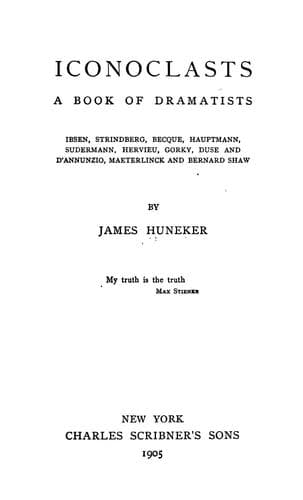
Iconoclasts: A Book of Dramatists: Ibsen, Strindberg, Becque, Hauptmann, Sudermann, Hervieu, Gorky, Duse and D'Annunzio, Maeterlinck and Bernard ShawHuneker, James
History
Iconoclasts: A Book of Dramatists: Ibsen, Strindberg, Becque, Hauptmann, Sudermann, Hervieu, Gorky, Duse and D'Annunzio, Maeterlinck and Bernard Shaw
Huneker, James
Dramatists; European drama -- 19th century -- History and criticism; European drama -- 20th century -- History and criticism
As to Mrs. Warren's Profession. It was played January 12, 1902, in
London, by the Stage Society. Mr. Grein says that Mrs. Warren's
Profession is literature for the study. The mother is a bore,
wonderfully done in spots (the spots especially) and the daughter a
chilly, waspish prig. The men are better; Sir George Crofts and the
philandering young fellow could not be clearer expressed in terms of
ink. I imagine that in a performance they must be extremely vital.
And that weak old _roué_ of a clergyman--why is Shaw so severe
on clergymen? For the rest, Mrs. Warren's Profession creates a
disagreeable impression, as the author intended it should. I consider
it his biggest, and also his most impossible, _opus_.
You Can Never Tell, Arms and the Man, Candida, and The Devil's Disciple
are a quartet difficult to outpoint for prodigal humour and ingenious
fantasy. In London the first named was voted irresistibly funny. It is
funny, and in a new way, though the framework is old-fashioned British
farce newly veneered by the malicious, the roistering humour of Shaw.
Arms and the Man and The Devil's Disciple have been in Mr. Mansfield's
repertory for years; they need no comment further than saying that the
first has something of the Gilbertian Palace of Truth topsy-turvying
quality (Louka is a free paraphrase of Regina in Ghosts, though she
talks Shaw with great fluency), with a wholly original content and
characterization; and the second is perverse melodrama.
Candida is not for mixed audiences. Christian socialism is caviare to
the general. In characterization there is much variety; the heroine--if
there be such an anomaly as a Shaw heroine--is most engaging. Every
time I read Candida I feel myself on the trail of somebody; it is all
in the air. The Lady from the Sea comes back when in that last scene,
where the extraordinary young poet Marchbanks, a combination of the
spiritual qualities of Shelley, Shaw, Ibsen's Stranger, and Shelley
again, dares the fatuous James Morell to put his wife Candida to the
test. It is one of the oddest situations in dramatic literature, and it
is all "prepared" with infinite skill. The dénouement is another of Mr.
Shaw's shower baths; withal a perfectly proper and highly moral ending.
You grind your teeth over it, as Mr. Shaw peeps across the top of the
page, indulging in one of his irritating dental displays.
The Man of Destiny is a mystification in one act. Napoleon talks the
purest Balzac when he describes the English, and Mr. Shaw manipulates
the wires industriously. It's good sport of its genre.
Public-domain text, read in full here on John Shaqi.
Reviews
Reviews
No reviews yet
Be the first to share your thoughts on this work.
Elsewhere in the archive
Join the Discussion
Join the discussion
Sign in to leave a comment or review.
Sign InorCreate an account