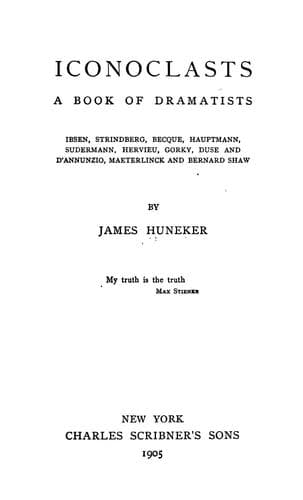
Iconoclasts: A Book of Dramatists: Ibsen, Strindberg, Becque, Hauptmann, Sudermann, Hervieu, Gorky, Duse and D'Annunzio, Maeterlinck and Bernard ShawHuneker, James
History
Iconoclasts: A Book of Dramatists: Ibsen, Strindberg, Becque, Hauptmann, Sudermann, Hervieu, Gorky, Duse and D'Annunzio, Maeterlinck and Bernard Shaw
Huneker, James
Dramatists; European drama -- 19th century -- History and criticism; European drama -- 20th century -- History and criticism
Captain Brassbound's Conversion is pure farce. But the joy of Cæsar
and Cleopatra is abounding. You chortle over it as chortled Stevenson
over the footman. A very devil of a play, one to read after Froude,
Michelet, Shakespeare, or Voltaire for the real facts of the case.
Since Suetonius, it is the first attempt at true Cæsarean history. And
the stage directions out-Maeterlinck Maeterlinck with their elaborate
intercalations. The gorgeous humour of it all!
Arms and the Man has been translated into German and played in Germany.
What will the Germans say to Cæsar and Cleopatra? They take Shaw too
seriously now, which is almost as bad as not taking him seriously at
all. What will the doctors of history do when the amazing character of
Cleopatra is dissected? If Shaw had never written another line but this
bubbling study of antiquity, in which the spirit of the opera bouffe
has not entered, he would be entitled to a free pass to that pantheon
wherein our beloved Mark Twain sits enthroned. It is all truth-telling
on a miraculous plane of reality, a reality which modulates and merges
into fantasy. One almost forgets the prefaces and the notes after
reading Cæsar and Cleopatra.
Whether he will ever vouchsafe the world a masterpiece, who can say?
Why demand so much? Is not he in himself a masterpiece? It depends on
his relinquishment of a too puritanical attitude toward art, life, and
roast beef. He is too pious. Never mind his second-hand Nietzsche, his
Diabolonian ethics, and his modern version of Carlylean Baphometic
Baptisms. They are all in his eye--that absolutely normal eye with the
suppressed Celtic twinkle. He doesn't mean a word he utters. (Who does
when writing of Shaw?) I firmly believe he says his prayers every night
with the family before he goes to his Jaeger-flannel couch!
II
Candida is the very quintessence of her creator. Many prefer this
sprightly sermon disguised as a comedy to Mr. Bernard Shaw's more
serious works. Yet serious it is. No latter-day paradoxioneer--to coin
a monster word, for the Shaws, Chestertons, _et al_.--evokes laughter
so easily as the Irishman. His is a cold intellectual wit, a Swiftian
wit, minus the hearty and wholesome obscenity of the great Dublin dean.
But it is often misleading. We laugh when we should reflect. We laugh
when we might better hang our heads--this is meant for the average
married and bachelor man. Shaw strikes fire in almost every sentence he
puts into Candida's honest mouth. After reading his eloquent tribute to
Ibsen, the crooked places in Candida become plainer; her mission is not
alone to undeceive but to love; not only to bruise hearts but to heal
them.
Public-domain text, read in full here on John Shaqi.
Reviews
Reviews
No reviews yet
Be the first to share your thoughts on this work.
Elsewhere in the archive
Join the Discussion
Join the discussion
Sign in to leave a comment or review.
Sign InorCreate an account