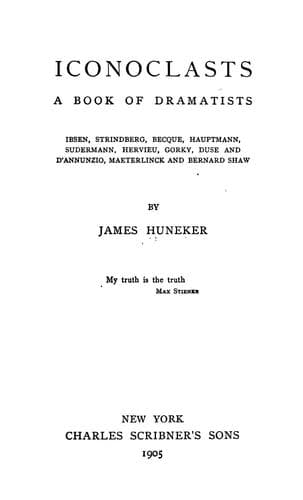
Iconoclasts: A Book of Dramatists: Ibsen, Strindberg, Becque, Hauptmann, Sudermann, Hervieu, Gorky, Duse and D'Annunzio, Maeterlinck and Bernard ShawHuneker, James
History
Iconoclasts: A Book of Dramatists: Ibsen, Strindberg, Becque, Hauptmann, Sudermann, Hervieu, Gorky, Duse and D'Annunzio, Maeterlinck and Bernard Shaw
Huneker, James
Dramatists; European drama -- 19th century -- History and criticism; European drama -- 20th century -- History and criticism
In a singularly vivid passage on page 38 of The Quintessence of
Ibsenism, Mr. Shaw writes: "When Blake told men that through excess
they would learn moderation, he knew that the way for the present lay
through the Venusberg, and that the race would assuredly not perish
there as some individuals have, and as the Puritans fear we all shall
unless we find a way round. Also, he no doubt foresaw the time when our
children would be born on the other side of it, and so be spared the
fiery purgation."
This sentiment occurs in the chapter devoted to a consideration of
The Womanly Woman. Let us look at the phrases on the printed page of
Candida that might be construed as bearing upon the above, or, rather,
the result of the quoted passage.
Candida speaks to James, her husband, in Act II:--
Don't you understand? I mean, will he forgive me for not teaching
him myself? For abandoning him to the bad woman for the sake of my
goodness--my purity, as you call it? Ah, James, how little you
understand me, to talk of your confidence in my goodness and purity!
I would give them both to poor Eugene as willingly as I would give my
shawl to a beggar dying of cold, if there were nothing else to restrain
me. Put your trust in my love for you, James, for if that went I should
care very little for your sermons--mere phrases that you cheat yourself
and others with every day.
Here is one of the most audacious speeches in any modern play. It has
been passed over by most English critics who saw in Candida merely an
attempt to make a clergyman ridiculous, not realizing that the theme is
profound and far-reaching, the question put being no more and no less
than: Shall a married man expect his wife's love without working for
it, without deserving it? Secure in his conviction that he was a model
husband and a good Christian, the Rev. James Mavor Morell went his way
smiling and lecturing. He had the "gift of gab," yet he was no humbug;
indeed, a sincerer parson does not exist. He is quite as sincere as
Pastor Manders, much broader in his views, and consequently not half so
dull.
Public-domain text, read in full here on John Shaqi.
Reviews
Reviews
No reviews yet
Be the first to share your thoughts on this work.
Elsewhere in the archive
Join the Discussion
Join the discussion
Sign in to leave a comment or review.
Sign InorCreate an account