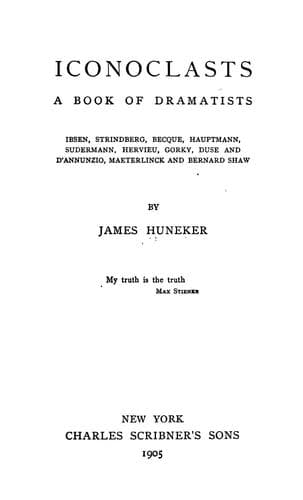
Iconoclasts: A Book of Dramatists: Ibsen, Strindberg, Becque, Hauptmann, Sudermann, Hervieu, Gorky, Duse and D'Annunzio, Maeterlinck and Bernard ShawHuneker, James
History
Iconoclasts: A Book of Dramatists: Ibsen, Strindberg, Becque, Hauptmann, Sudermann, Hervieu, Gorky, Duse and D'Annunzio, Maeterlinck and Bernard Shaw
Huneker, James
Dramatists; European drama -- 19th century -- History and criticism; European drama -- 20th century -- History and criticism
But he is, nevertheless, a bit of a bore, with his lack of humour
and his grim earnestness. No doubt Shaw took his fling at that queer
blending of Christianity and socialism, that Karl Marx in a parson's
collar which startled London twenty years ago in the person of the
Christian socialist clergyman. He saw, too, being a man with a sense
of character values and their use in violent contrast, that to the
rhapsodic and poetic Eugene Marchbanks, Morell would prove a splendid
foil. And so he does. Between this oddly opposed pair stands on her
solid, sensible underpinnings the figure of Candida. Realist as is Mr.
Shaw, he would scout the notion of his third act being accepted as a
transcript from life. For two acts we are in plain earthly atmosphere;
unusual things happen, though not impossible ones. In the last act
Shaw, droll dramatist and acute observer of his fellow-man's foibles,
disappears, only to return in the guise of Shaw the preacher.
And how he does throw a sermon at our heads! The play is arrested in
its mid-ocean, and the shock throws us almost off our feet. Do not
be deceived. That mock bidding for the hand of Candida, surely the
craziest farce ever invented, is but this author's cunning manner of
driving home his lesson. Are you worthy of your wife? Is the woman who
swore to love and honour you ("obey" is not in the Shaw vocabulary,
thanks to J. S. Mill) worthy of you? If your love is not mutual then
better go your ways--you profane it! Is this startling? Is this novel?
No and yes. The defence of love for love's sake, coming from the lips
of a Shaw character, has a surprising effect, for no man is less
concerned with sex questions, no man has more openly depreciated the
ascendancy of sex in art and literature. He would be the first to
applaud eagerly Edmund Clarence Stedman's question apropos of Walt
Whitman's Leaves of Grass: Is there no other light in which to view
the beloved one than as the future mother of our children? (I trust
to a treacherous memory; the meaning is expressed, though not in Mr.
Stedman's words.)
Public-domain text, read in full here on John Shaqi.
Reviews
Reviews
No reviews yet
Be the first to share your thoughts on this work.
Elsewhere in the archive
Join the Discussion
Join the discussion
Sign in to leave a comment or review.
Sign InorCreate an account