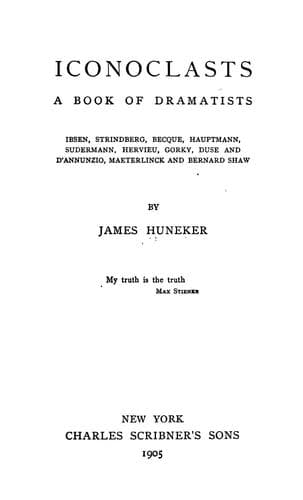
Iconoclasts: A Book of Dramatists: Ibsen, Strindberg, Becque, Hauptmann, Sudermann, Hervieu, Gorky, Duse and D'Annunzio, Maeterlinck and Bernard ShawHuneker, James
History
Iconoclasts: A Book of Dramatists: Ibsen, Strindberg, Becque, Hauptmann, Sudermann, Hervieu, Gorky, Duse and D'Annunzio, Maeterlinck and Bernard Shaw
Huneker, James
Dramatists; European drama -- 19th century -- History and criticism; European drama -- 20th century -- History and criticism
The keepers of the night asylum are a man and wife, a trifle better
off than their lodgers in physique, for they are not drunkards. The
husband is past fifty, an avaricious, snuffling, shuffling hypocrite,
jealous of his young wife and brutal to the people he harbours. His
wife is only twenty-six and hates her husband. She loves a young,
good-looking thief who lives in the cellar, an aristocrat among his
fellows, for he sleeps alone in a sort of cupboard, and only works at
his "profession" when he needs money. He gets the hottest tea and the
nicest morsels from the shrewish woman. Her voice, raucous and full
of fury, is softened when she addresses her Wasjka. His companions
know all about this affair, but are not jealous of him; they are too
indifferent to everything but their own wants to care for God or man,
devils or angels. They are over-tramps, beings for whom the moralities,
major and minor, no longer have any meaning. The thief is tired of the
woman, tired of his life amid stupid people, and has cast his eyes on
Natascha, the sister of his mistress. The elder woman realizes it and
trouble is brewing when the curtain goes up.
It is morning. A dull light filters from above on a mass of almost
shapeless figures. One by one they stir. Yawns, half-stifled oaths,
coughing, expectorations, noses noisily blown, whinings, cries of
pain, harsh laughter, and suppressed sobbing--the hideous symphony of
life at its lowest social ebb. Again you feel like averting your head,
for such is the force of suggestion that a noisome odour seems to
emanate from the stage and creep languidly through the auditorium.
The other _dramatis person_: a policeman, uncle to the sisters; a
locksmith with a dying wife--dying of consumption brought on by
the prolonged beatings at the hands of her semi-insane husband; a
street-walker--one who reads sentimental novels and speaks at intervals
of a romance she had when younger; a huck-stress, cynical, drunken,
loud-mouthed; a cap-maker who never works; an actor who has forgotten
his professional name, poisoned with alcohol; a man named Satin, a
good-natured, degenerate scoundrel; a decayed baron, neurasthenic, and
with a face that recalls one of Doré's sketches of a damned soul--lean,
always biting his nails, stuttering, his eyes blazing with the infernal
fires of vodka madness; an old man of venerable aspect, a pilgrim who
happens in; his name is Luka and he is some sixty years of age. Then
there is a young scapegrace shoemaker who plays the concertina and
always describes himself as a free man, a man without cares, a man who
would not accept wealth if offered him. A Tartar and several porters
and members of the barefoot brigade make up this unattractive company.
Public-domain text, read in full here on John Shaqi.
Reviews
Reviews
No reviews yet
Be the first to share your thoughts on this work.
Elsewhere in the archive
Join the Discussion
Join the discussion
Sign in to leave a comment or review.
Sign InorCreate an account