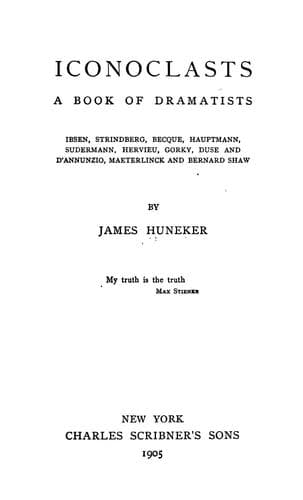
Iconoclasts: A Book of Dramatists: Ibsen, Strindberg, Becque, Hauptmann, Sudermann, Hervieu, Gorky, Duse and D'Annunzio, Maeterlinck and Bernard ShawHuneker, James
History
Iconoclasts: A Book of Dramatists: Ibsen, Strindberg, Becque, Hauptmann, Sudermann, Hervieu, Gorky, Duse and D'Annunzio, Maeterlinck and Bernard Shaw
Huneker, James
Dramatists; European drama -- 19th century -- History and criticism; European drama -- 20th century -- History and criticism
The amateur of sensations, exquisite, morbid, or brutal, must feel
after Nachtasyl that the bottomless pit has been almost plumbed. What
further exploitation of woe, of crime, of humanity stripped of its
adventitious social trappings, can be made? And this question is put
by every generation without in the least stopping the fresh shaking
up of the dramatic kaleidoscope. The Gorky play, even if it disgusts
at times, at least arouses pity and terror, and thus, according to
the classical formula, purges the minds of its spectators. Compared
to the drama of lubricity manufactured in Paris and annually exported
to America, this little study of a group of outcast men and women
is a powerful moral lesson. That it is a play I do not assert, nor
could it be put on the boards in America without a storm of critical
and public censure. Americans go to the theatre to be amused and not
to have their nerves assaulted. Thackeray, in a memorable passage of
Vanity Fair, refused to stir those depths of humanity where lurk all
manners of evil monsters. Perhaps this refusal was for the great writer
an artistic renunciation; perhaps he knew the British public. In our
own happy, sun-smitten land, where poverty and vice abound not, where
the tramp is only a creation of the comic journals--in America, if
such a truth-teller as Gorky arose, we should fall upon him, neck and
crop, gag him, and without bothering over the formality of a writ _de
lunatico inquirendo_, clap the fellow behind the bars of a madhouse
cell. It would serve him right. The ugly cancers of the social system
should never be exposed, especially by a candid hand! In art, to tell
truths of this kind does not alone shame the devil, but outrages the
community. No wonder Emperor William does not grace such performances
by his presence. No wonder Gorky is a suspect in Russia. He tells the
truth, which in the twentieth century is more dangerous than hammering
dynamite!
One detail I have forgotten. Old Luka the Pilgrim is asked by Wasjka
Pepel where he purposes travelling after he leaves their haunt. To
Little Russia, he says, adding that he has heard of a new faith being
preached out there, and he will see if there is anything in it. There
might be--men search and search for better things.... If God will but
give them patience, all will be well! Perhaps this new preacher has
found the light! It is a touch unmistakably of Russia, where even the
irreligious are not without faith. Gorky, with all his moral anarchy,
is as superstitious as a _moujik._ He shakes his fists at the eternal
stars and then makes the sign of the cross. It may be for that reason
he wrote The Night Refuge.
_De profundis ad te clamavi!_
VIII
HERMANN SUDERMANN
Public-domain text, read in full here on John Shaqi.
Reviews
Reviews
No reviews yet
Be the first to share your thoughts on this work.
Elsewhere in the archive
Join the Discussion
Join the discussion
Sign in to leave a comment or review.
Sign InorCreate an account